The Most Credible Modern Loch Ness Sightings (1960–Today)
Most Loch Ness sightings are brief, unrecorded and impossible to test. A small number are different: they were filmed, photographed, sonar-tracked or logged by careful observers. This guide looks at the most credible modern cases since 1960, what was actually recorded, and how each one holds up today. For the earlier history, start with our complete timeline of the first 1,100 sightings.
Why 1960 is the turning point
Before 1960, nearly all evidence was eyewitness testimony plus a few disputed photographs, the most famous of which, the Surgeon's Photograph, was later shown to be a hoax. In 1957 Dr Constance Whyte published More Than a Legend, a collection of eyewitness accounts that persuaded many people Nessie deserved serious study. Within a decade, amateurs and universities alike were bringing cameras and sonar to the loch (PBS NOVA).
1960: Tim Dinsdale's film
On his first expedition in April 1960, aeronautical engineer Tim Dinsdale filmed a dark hump moving across the loch near Foyers. He was so convinced that he gave up his engineering career and spent the rest of his life searching for the animal (PBS NOVA; Wikipedia).
Why it matters: it is moving film, shot by a trained engineer who also filmed a boat for comparison. Credibility note: analysts still disagree. Supporters point to a 1966 analysis by the RAF's photographic interpretation unit, which judged the object probably animate. Sceptics argue the footage shows a boat, and later enhancements remain disputed.
1962–1972: The Loch Ness Investigation Bureau
In 1962 a group of volunteers formed the Loch Ness Investigation Bureau and kept watch with cameras from fixed points along the shore (PBS NOVA). Over a decade of watching produced many reports but no clear film. Researchers often read this as useful evidence in its own right: long, organised surveillance turned up much less than casual tourist reports would suggest.
1972 and 1975: The Rines underwater photographs
Dr Robert Rines and the Academy of Applied Science, working with the Bureau in 1972, set up an underwater time-lapse camera linked to sonar. On the night of 7–8 August 1972 it captured the famous "flipper" images (Loch Ness Investigation). The team returned on its own in 1975 and photographed what was claimed to be a body and a "gargoyle head" (loch-ness.org).
Credibility note: these images were computer-enhanced before they were published, and the unenhanced originals look far less clear. Dick Raynor, who crewed the Bureau boat that night, has published a detailed critique questioning the flipper images (Loch Ness Investigation). Most researchers now treat them as unproven at best.
1987: Operation Deepscan
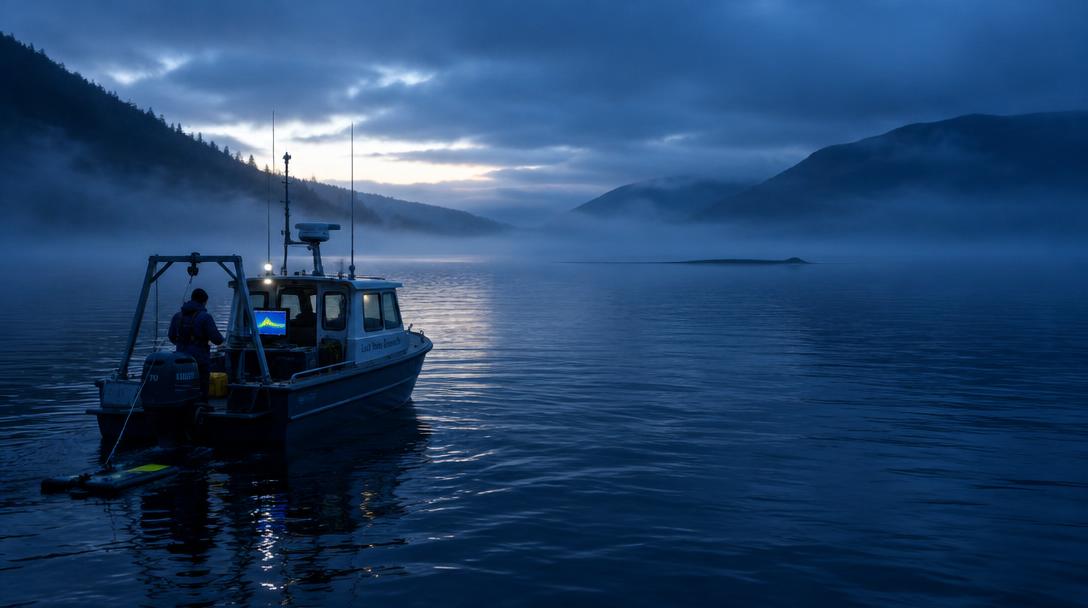
In October 1987, a line of boats fitted with echo sounders swept the length of the loch side by side, in the most ambitious sonar survey ever attempted there. It recorded three underwater contacts that were never explained (PBS NOVA).
Credibility note: the contacts were strong but short. Possible explanations include seals, large fish, debris and thermal layers in the water. Deepscan's lasting value is the scientific groundwork it laid. Much of that came from Adrian Shine's Loch Ness Project.
2018: The eDNA survey
Professor Neil Gemmell's team sampled DNA from the loch's water. They found no reptile DNA, but a great deal of eel DNA. Read the full breakdown in our article on the Neil Gemmell DNA experiment. This study now sets the bar any modern sighting has to clear.
2021–today: Webcams and the Official Sightings Register
Since 2021, a growing share of entries in the Official Loch Ness Monster Sightings Register have come from people watching live webcams online, rather than from witnesses at the loch. These reports are easy to check because the footage is stored. Most turn out to be boat wakes, birds or waves. A few stay unexplained and get logged. You can see where reports cluster on our sightings heatmap.
How to judge a modern sighting
- **Recorded evidence beats memory.** Film, sonar logs and timestamped webcam frames can be checked again later.
- **Scale matters.** Without a reference object, size estimates on open water are unreliable. Our guide to how big Loch Ness is explains why the loch makes this especially hard.
- **Look for the boring explanation first.** Boat wakes, standing waves, swimming deer, otters, cormorants and floating logs explain most reports.
- **Check the originals.** Be cautious of evidence that only exists in enhanced form.
The verdict
No modern case proves a large unknown animal lives in Loch Ness. Even so, the Dinsdale film, the Deepscan contacts and the unexplained webcam reports remain the strongest material researchers have, and they are worth studying for what they teach about observation, perception and the loch itself. Browse all documented sightings to compare the cases yourself.