Alfred Cruickshank’s 1923 Loch Ness Monster Sighting: What Did He See Near Invermoriston?
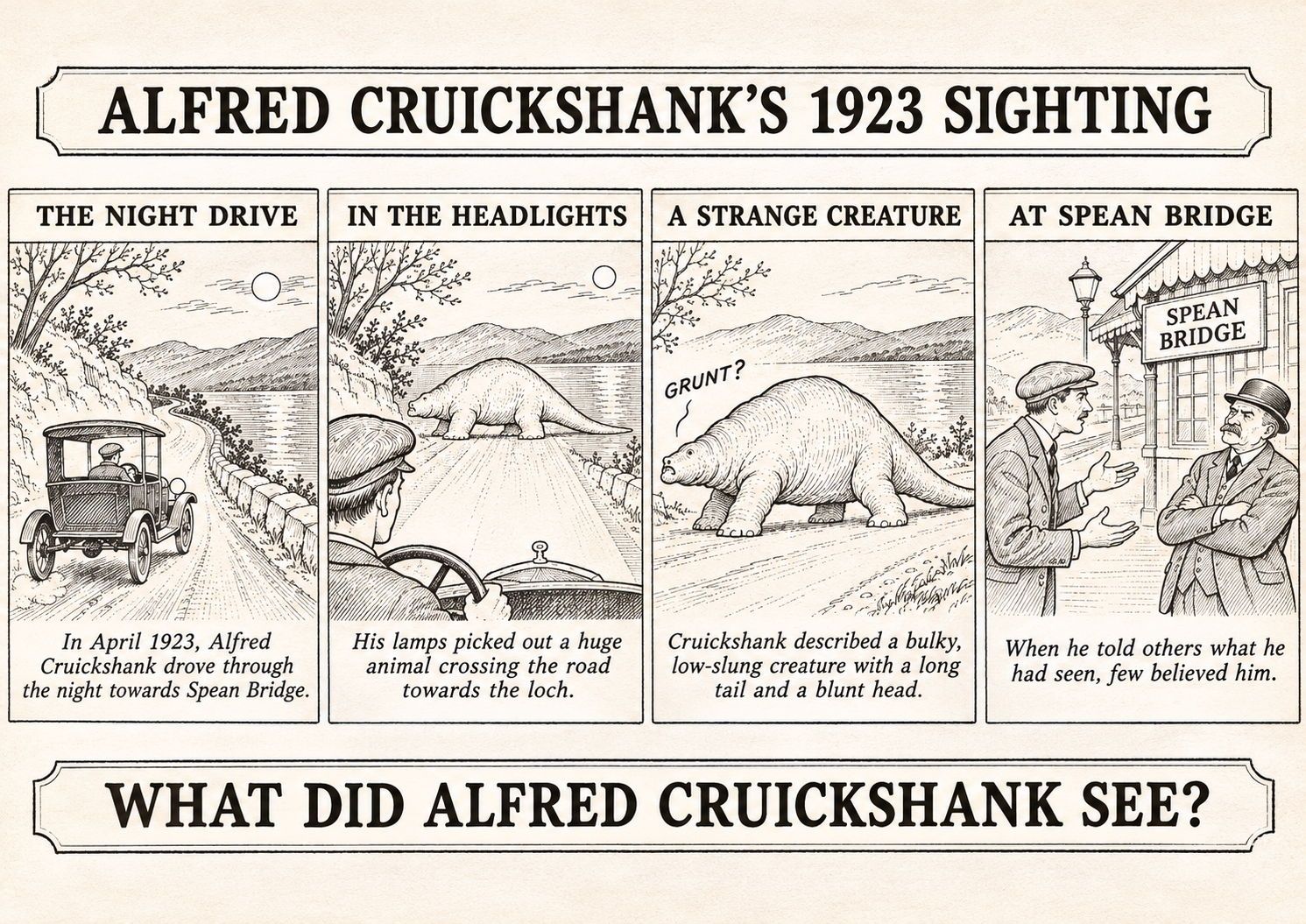
Long before the Loch Ness Monster became an international newspaper sensation in 1933, Alfred Cruickshank claimed to have encountered something extraordinary on the road beside the loch.
His sighting supposedly took place in April 1923, ten years before Aldie Mackay’s famous report helped launch the modern Nessie story. Cruickshank was not looking for monsters and, according to his own account, he did not publicise what had happened at the time.
Instead, he was driving through the Highlands in the middle of the night in a Model T Ford when his headlights illuminated a huge animal crossing the road ahead of him.
It is one of the strangest of the early Loch Ness land sightings because Cruickshank’s creature bears surprisingly little resemblance to the familiar long-necked Nessie that emerged during the 1930s.
It had a huge humped body, a very long tail, thick legs, large feet, a belly hanging close to the ground and apparently very little neck.
Cruickshank thought it looked something like an enormous hippopotamus.
- Date: A Monday morning in April 1923
- Location: Around two miles north of Invermoriston
- Distance when first seen: Approximately 50 yards
- Body: About 10–12 feet long
- Height: Roughly 5 ft 6 in to 7 feet
- Tail: About 10–12 feet long
- Legs: Thick, compared with an elephant’s
- Feet: Described as large and webbed in the 1961 account
- Colour: Green-khaki/dark olive, lighter underneath
- Head: Large, pug-nosed, apparently with little neck
- Movement: Slow, waddling
- Sound: Described as a bark in one account and a grunt in another
- Direction: Crossing the road towards Loch Ness
The sighting is listed as Register No. 39 in the Loch Ness Sightings Register and sits among a surprising number of claimed observations from before the better-known 1933 wave. The broader chronology can also be explored in the complete Loch Ness sightings timeline and all Loch Ness Monster sightings.
Alfred Cruickshank’s Journey to Spean Bridge
The most useful account comes from Cruickshank himself.
On 9 January 1961, he wrote to Tim Dinsdale, who had recently attracted national attention after filming a moving object on Loch Ness in April 1960. Cruickshank’s letter was subsequently included in Dinsdale’s book Loch Ness Monster. A later reproduction of the correspondence gives considerable detail about the journey and the sighting.
Cruickshank was living in Buckie, Banffshire, and regularly drove to Spean Bridge to meet an 8 a.m. train arriving from Glasgow. To make the journey he said he normally left home at around 3 a.m., covering about 112 miles on roads he described as narrow and rough.
This was not an unfamiliar journey. Cruickshank claimed he had driven it hundreds of times.
His car was a Model T Ford, and one detail becomes particularly important when considering the sighting: the headlights were powered from the vehicle’s magneto system.
Cruickshank explained that the faster the engine ran, the brighter the lights became. When the engine slowed for a corner, the headlights faded.
That is exactly what happened as he approached the animal.
A Large Object in the Headlights
Cruickshank later told Nicholas Witchell that he was about two miles north of Invermoriston when he came over a small rise and saw something ahead of him.
The object was on the outside of a bend, perhaps 50 yards away.
At first it was simply something large moving in the road.
As the Ford approached, Cruickshank began trying to make sense of what his headlights were illuminating.
He described a large, humped body perhaps 10 or 12 feet long, standing somewhere around six feet high. Attached to it was an unusually long and thick tail, also estimated at 10 to 12 feet.
If those estimates were accurate, the complete animal could therefore have approached 20 to 24 feet in length.
The belly appeared to hang extremely low, almost dragging along the ground.
The 1961 account described four thick legs like those of an elephant, ending in large webbed feet. In the later Witchell account, Cruickshank said that he could see the two legs on the side nearest him as the animal moved slowly away.
Its gait was not fast.
He described it as waddling.
The colour was variously remembered as green-khaki or dark olive, with a paler or cream underside. Cruickshank himself recognised the problem with judging colour because the observation was taking place at night under primitive vehicle lighting.
The description bears little resemblance to the classic long-necked image associated with the George and Mrs Spicer road-crossing report of 1933 or the later Arthur Grant motorcycle encounter near Abriachan.
That is part of what makes the Cruickshank report so peculiar.
The Head Had Almost No Neck
Cruickshank’s description of the head is particularly interesting.
In the later account recorded by Nicholas Witchell he said that he could see the outline of a large, pug-nosed head, apparently attached directly to the body.
He specifically said that it did not seem to have much of a neck.
That creates an obvious problem for anyone trying to fit the sighting into the traditional plesiosaur-type interpretation of Nessie.
The animal Cruickshank described was not a small-headed creature with a long, slender neck.
It was almost the reverse.
The head was large, the neck apparently very short, the body enormous and the tail exceptionally long.
Cruickshank compared its overall appearance with an enormous hippopotamus, although with an arched back and a long trailing tail.
The Lights Began to Fade
As Cruickshank approached the bend he had to slow the Ford.
As he did so, his headlights became dimmer.
The animal was therefore disappearing from clear view at almost exactly the point when he was closest to it.
The two later accounts differ slightly over what happened next.
In his 1961 letter, Cruickshank said the creature gave out a sharp bark like a dog as it disappeared across the road towards the water. The later Witchell account records a grunting noise after Cruickshank had rounded the corner.
Those differences are worth retaining rather than choosing whichever version sounds most dramatic.
Nearly four decades separated the alleged event from the Dinsdale letter, and another decade or more had passed before Witchell interviewed him.
We have to take into account human memory is not a recording.
Details can change without requiring the witness to be dishonest.
Why Didn’t Cruickshank Turn Around?
Once he had negotiated the bend, Cruickshank stopped.
He later said that he could not easily turn the Model T around because the road was too narrow.
More importantly, he had no intention of walking back in the darkness to investigate whatever he had just encountered.
That seems understandable given the size of the animal he thought he had seen.
He simply continued towards Spean Bridge.
When he arrived at the station, according to the Witchell version, his employer noticed that he looked pale and apparently assumed he had been involved in an accident.
Cruickshank told him what had happened.
His employer thought he must have been dreaming.
Cruickshank also said that a couple of friends suggested that he had been drunk.
After that he largely kept the story to himself, although he told his wife. In his earlier letter to Dinsdale he said his wife and employer were essentially the only people he had told.
The reaction may help explain why the story did not become public in 1923.
There was no established Loch Ness Monster media phenomenon waiting to receive it.
The famous Aldie and John Mackay report was still ten years away, as was the extraordinary explosion of sightings that followed during 1933. That later period can be compared with Cruickshank’s case through the Loch Ness Newspaper Archive.
What Was the Exact Date?
Cruickshank could not provide a precise date.
In 1961 he wrote:
“If I remember rightly it was on a Monday morning in April, 1923…”
This is important because even Cruickshank was making clear that he was relying on memory.
If the Monday recollection was correct, the possible dates were 2, 9, 16, 23 or 30 April 1923.
There is no evidence currently available that allows us to choose between them.
The common dating of the encounter as simply April 1923 is therefore the most accurate one.
Where Exactly Did It Happen?
Cruickshank said he could still identify the place decades later, although he noted that the road had since been substantially rebuilt and widened.
The usual location is given as roughly two miles north of Invermoriston.
Later researchers have tried to identify a suitable bend in the old road. One investigation proposed the Altsigh area, somewhat farther north depending on exactly where the distance is measured, because the older road alignment there appears more consistent with Cruickshank’s description. That identification remains speculative rather than established.
The modern road cannot simply be used as a direct representation of what Cruickshank saw in 1923.
Road improvements around Loch Ness changed alignments, widths and gradients considerably during the following decade.
The geography can be explored alongside the locations of other reports on the Loch Ness sightings heatmap and the site’s interactive 3D model of Loch Ness.
A Story Told Nearly Forty Years Later
This is the largest problem with the Cruickshank sighting.
There is no known contemporary 1923 newspaper report.
There is no photograph.
There are no tracks.
There is no physical evidence.
There is apparently no surviving written statement from Cruickshank dating from anywhere near the time of the event.
The detailed account we have comes from 1961, approximately 38 years later.
That does not mean the event never happened. People can remember frightening or unusual incidents for their entire lives.
But it means that measurements such as “10–12 feet”, “six feet high” and “50 yards” cannot reasonably be treated as surveyed dimensions.
Cruickshank was remembering a brief nocturnal encounter experienced decades earlier.
His later interview with Nicholas Witchell adds information but also introduces differences.
That is exactly the sort of source problem that appears repeatedly when working through the older entries in the historical Loch Ness Sightings Register.
The Story Apparently Stayed in the Family
There is one interesting piece of later testimony.
A researcher who traced Cruickshank’s grandson in Buckie reported that the grandson remembered Alfred sitting him on his knee and telling him about the night he encountered the Loch Ness Monster.
Cruickshank died in 1978.
Family recollection cannot prove what happened on that road or establish when the story first took shape, but it suggests that Cruickshank also told it privately.
Cruickshank also recalled another alleged pre-1930 land sighting. He told Witchell about a young woman working in a Fort Augustus baker’s shop who had apparently seen a large animal lying on a beach near the village. She was said to have been so frightened that she abandoned her bicycle and ran home.
There are other early land reports in the record, including the disputed Cameron and MacGruer family encounter and the earlier James Cameron close encounter.
None verifies Cruickshank’s story, but it shows that the idea of large animals being seen around the shores of Loch Ness did not begin with the Spicers in 1933.
So What Could Alfred Cruickshank Have Seen?
More than a century later there is no way to identify the animal with confidence.
The description is strange enough that almost every conventional explanation solves one part of the story while creating another problem.
A Horse, Cow or Deer
A large ordinary land mammal encountered unexpectedly in poor headlights would be the simplest explanation.
A horse could account for the height. A cow could present a huge body. A deer seen from an odd angle might be badly misjudged at night.
But none fits the full description particularly well.
Cruickshank specifically described an animal with a belly hanging close to the road, very thick short legs and a tail approximately as long as its body.
A horse, cow or red deer simply does not have that anatomy.
That does not rule out misidentification, because some of those anatomical details may have been products of poor lighting or later memory rather than features the animal actually possessed.
A Seal
Seals occasionally enter freshwater systems and are an obvious candidate when discussing unidentified animals around Loch Ness.
They can also produce surprisingly strange silhouettes on land.
The problem is scale.
A seal large enough to match Cruickshank’s dimensions would be extraordinary, and his description of four substantial legs and a 10–12 foot tail does not resemble a seal.
A seal also tends to move on land very differently from the elephant-legged waddling animal he described.
An Otter
An otter can appear long-bodied, low-slung and somewhat reptilian when briefly illuminated.
It has a long tail and is naturally associated with water.
The difficulty is again size.
Cruickshank thought he was looking at an animal perhaps six feet high and more than 20 feet long including the tail.
For an otter to produce that impression at around 50 yards would require a spectacular error of scale.
Possible under poor night-time conditions, perhaps, but not an especially comfortable fit.
An Escaped Exotic Animal
Cruickshank’s own comparison with a hippopotamus makes an escaped zoo or private animal tempting.
A hippo could provide the massive body, short legs, low belly and large blunt head.
It fails badly on the tail.
A hippopotamus has nothing resembling the enormous tapering tail Cruickshank described.
There is also no evidence presently known of a missing hippo or comparable exotic animal wandering beside Loch Ness in April 1923.
Without such evidence the explanation simply replaces one unknown animal with another.
A Giant Salamander
Cruickshank’s description has occasionally attracted comparisons with a giant salamander.
Of all the speculative animal models, the general body plan is interesting: broad head, little obvious neck, low body, four limbs and a long tail.
Large salamanders are also amphibious.
The problem is that no known salamander comes remotely close to the dimensions Cruickshank gave, and Scotland does not possess an indigenous giant salamander.
It therefore works as a comparison of shape rather than a zoological identification.
A Plesiosaur
The Cruickshank animal is a poor match for the popular plesiosaur version of Nessie.
Plesiosaurs had four flippers and some forms had long necks, but Cruickshank specifically described thick load-bearing legs, a waddling gait and almost no neck at all.
Plesiosaurs were marine reptiles adapted for swimming. The idea of one walking across a Highland road on elephant-like limbs does not fit modern understanding of their anatomy.
If Cruickshank saw an unknown animal, there is no particular reason from his description to call it a plesiosaur.
An Optical and Memory Problem
This is probably the strongest conventional possibility.
Cruickshank was driving alone at around four or five in the morning after leaving Buckie at approximately 3 a.m.
It was dark.
The road was narrow.
His headlights were comparatively poor and became dimmer as he slowed down.
The animal was initially about 50 yards ahead.
He had only a brief view before rounding the bend.
Those are almost ideal circumstances for an ordinary object to acquire extraordinary proportions.
Add another 38 years before the detailed written account and there is plenty of opportunity for genuine memory to become more definite than the original perception.
That does not require Cruickshank to have lied.
He could have seen a real animal and sincerely remembered exactly what he later described while nevertheless being wrong about its size or anatomy.
A Hoax
The possibility that Cruickshank invented the story cannot be excluded.
Sceptical writer Ulrich Magin reportedly suggested that the April dating might indicate an April Fool story. The argument is not particularly convincing on its own. Cruickshank remembered the event as occurring on a Monday, while 1 April 1923 was not a Monday.
There is also an unusual feature of the account if it was invented after Nessie had become famous.
Cruickshank did not describe the fashionable monster.
By 1961 the image of Nessie as a long-necked aquatic animal was thoroughly established. Someone simply wanting to insert himself into the legend could easily have described that.
Instead, Cruickshank offered an awkward animal with a huge body, almost no neck, a pug-like head, elephantine legs and a frog-like colour.
That does not make the story true, but it is certainly an odd choice for a straightforward imitation of better-known Nessie reports.
Could He Have Seen an Unknown Animal?
That possibility ultimately depends on how much weight is given to eyewitness testimony.
If Cruickshank’s estimates and anatomical description are accepted literally, then there is no obvious large British animal that fits what he described.
But accepting those measurements literally is a considerable step.
The sighting occurred at night, lasted a short time and was reconstructed from memory decades afterwards.
There is also no independent evidence placing an unidentified animal on the road that morning.
The most cautious conclusion is that Alfred Cruickshank probably told Dinsdale and Witchell a story he genuinely regarded as an encounter with an extraordinary animal.
Whether the original stimulus was extraordinary is another matter.
It could have been a familiar animal badly perceived in failing headlights.
It could have been an incident altered by almost four decades of memory.
It could have been a story that grew in the telling.
Or Cruickshank could indeed have encountered something on the old road north of Invermoriston that remains unidentified.
What makes the case particularly enjoyable is that even after trying to explain it, the animal Cruickshank described still refuses to fit neatly into any of the usual boxes.
It is not really the classic Nessie.
It is not obviously a seal, otter, deer, horse or cow.
And it certainly is not a comfortable plesiosaur.
So what crossed the road in front of Alfred Cruickshank on a dark Monday morning in April 1923?
Sources and further reading
- Tim Dinsdale, Loch Ness Monster: Cruickshank’s letter dated 9 January 1961, as described in this account.
- Nicholas Witchell, The Loch Ness Story: the later interview account; the register cites page 131.
- Roy Mackal, The Monsters of Loch Ness: land sighting 7, as cited in the register.
- Register No. 39: Alfred Cruickshank’s Roadside Creature.