The Gargoyle Head: Loch Ness, 1975
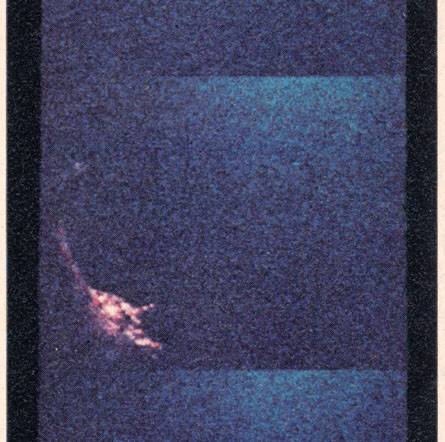
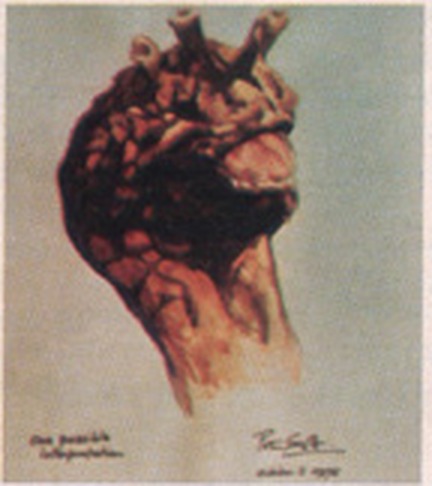
Late on the morning of 20 June 1975, a 16mm camera hanging beneath a boat in Urquhart Bay took a picture of something pale, lumpy and roughly symmetrical. Six months later it had been shown to MPs at Westminster, painted by Sir Peter Scott and described in an MIT journal as the head of a living animal. It became known as the gargoyle head.
Twelve years after that, a team working the same part of the bay found a waterlogged tree stump that looked a good deal like it. Most writers since have treated the case as closed.
This post covers what the photograph was, what the people who took it believed they had, how the stump entered the story, and how firm the identification is. The short version: the stump was lifted out of the loch in 1987, so it is not lurking anywhere. Whether that particular stump is the object in the 1975 frame is a narrower question, and the evidence for it is good but short of proof.
The 1975 expedition
The picture came from the Academy of Applied Science, the Boston group led by Robert Rines, a patent lawyer and inventor. His technical team included Harold Edgerton of MIT, who built the strobe, the photographic scientist Charles Wyckoff and the sonar engineer Martin Klein. The same group had produced the flipper pictures in Urquhart Bay in 1972.
For 1975 they set up two camera systems in the bay, described in their own report in Technology Review (March/April 1976):
- **The main system** sat on a ledge on the loch bed at about 80 feet. A sonar was meant to trigger it whenever something four or five feet across came within about 40 feet. It then took a frame every 15 seconds.
- **The backup system** was the 1972 rig: a camera and a strobe about five feet apart on a tubular frame, hung from a moored boat. The report puts it about 40 feet down and about 40 feet above the ledge. It fired on a timer, one frame roughly every 72 seconds, whether anything was there or not.
The main system produced nothing. Its lens was obscured by silt, which the team attributed to a large animal stirring up the bottom. Every picture that mattered came from the backup rig, in a run of under 24 hours on 19 and 20 June.
One point about that rig matters for everything that follows. The Academy's case depended on it hanging in mid-water, well clear of the bottom. Dick Raynor, who helped assemble it, has pointed out that it hung beneath a boat that was free to swing on its mooring.
The photograph
The Technology Review report lists six notable frames from the backup camera, lettered A to F, taken between 9.45 pm on 19 June and 4.50 pm on 20 June. Two became famous. The "body and neck" picture was taken at about 4.32 am on the 20th. The "head" followed at about 11.45 am.
The head was the centre frame of a run of seven. By the team's own account the camera was swinging upward during that run, and other frames in it show the underside of the boat. There was no sonar contact to go with it.
What the frame shows is a pale, knobbly mass against a blue background, with a dark notch on one side and several short projections. The Academy read it as an animal's head in half profile: an open mouth and nostrils to the right, and horn-like stalks on top. They put it about five feet from the lens and gave measurements:
| Feature | Academy estimate |
|---|---|
| Head length | about 2 feet |
| Neck thickness | about 1.5 feet |
| Mouth | about 9 by 5 inches |
| Central horn | about 6 inches |
| Gap between the two outer projections | about 10 inches |
They also admitted the object was not properly lit. At that range it sat outside the main strobe beam and was picked up by scattered light only.
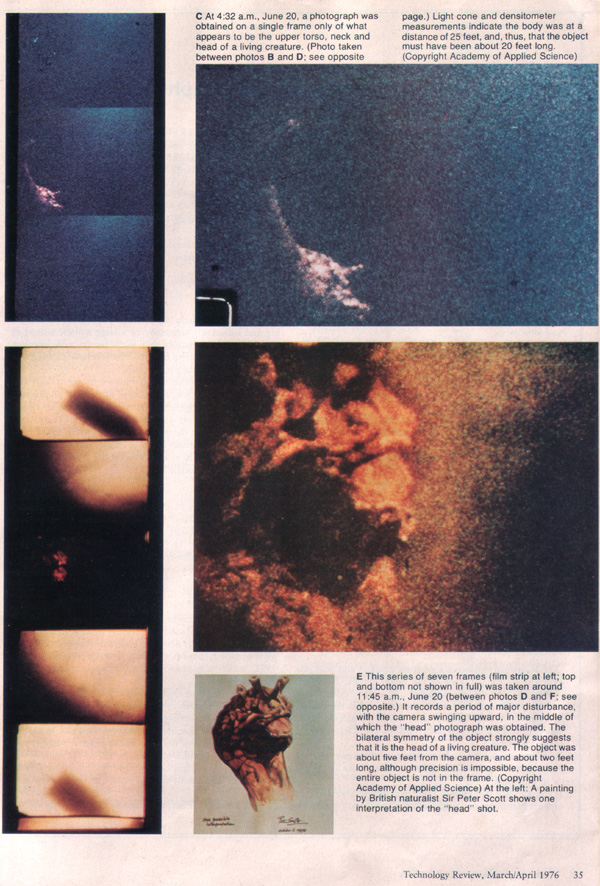
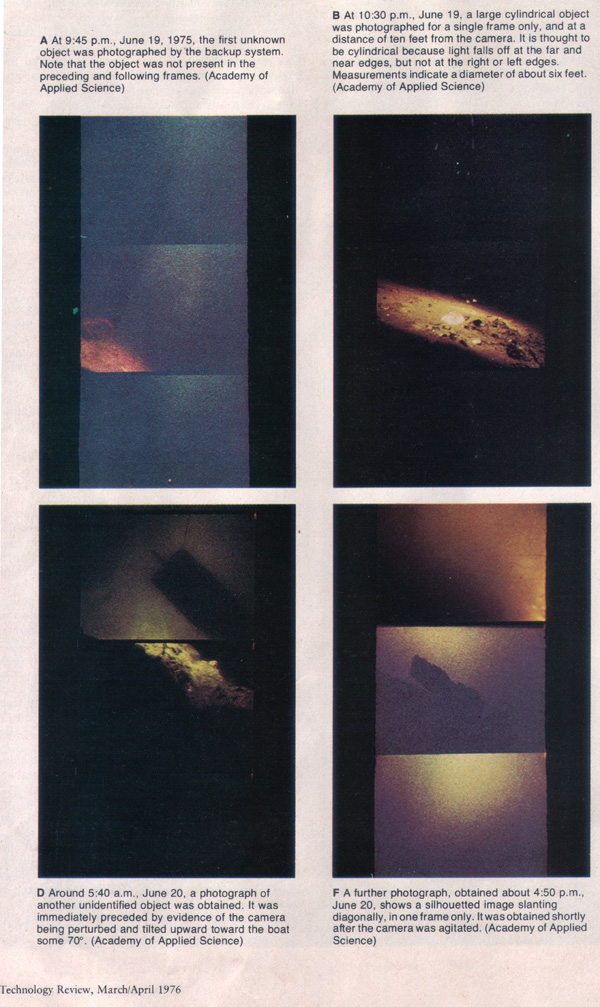
The full article, with the Academy's own markings over the frames, is in the Technology Review PDF hosted by Martin Klein.
What they thought it was
Rines believed he had the animal's face. He told Nicholas Witchell that the team held close-up colour photographs of the head, neck and body of one of the creatures, and Witchell was shown them in a darkened room before publication. Roland Watson's account of that episode notes that Witchell picked out horns on the head.
The horns were the selling point. Some surface witnesses over the years had described stalks or tubes on the head, and the Academy tied the 10-inch gap between the projections to a pair of parallel wakes photographed through a telescope the same year. Peter Scott painted the head as a short-faced, horned animal, and the horns were read by some as breathing tubes.
The Academy collected opinions from zoologists, printed alongside its report:
- George Zug of the Smithsonian saw symmetrical profiles suggesting living things, and offered that as a personal view.
- A. W. Crompton of Harvard described a smallish head on a thick neck but could not say what animal it was.
- The report itself leaned on bilateral symmetry as the sign of an animate object.
- Zoologists at the British Museum (Natural History) were the cautious ones. They found the pictures too indistinct to identify and said floating debris could produce such shapes.
Then it went public. A scientific symposium planned for Edinburgh in December 1975 was called off as press interest got out of hand, and the pictures were instead presented at a meeting in the House of Commons arranged by David James MP. On 11 December, Nature carried Scott and Rines's article giving the animal a formal name, *Nessiteras rhombopteryx*, so that it could be listed for legal protection. The name rested mainly on the 1972 flippers, but the 1975 head and body pictures were part of the package.
The reception was poor. The name was soon noticed to be an anagram of "Monster hoax by Sir Peter S", which nobody now thinks was intended. Rines later said of the head picture that he had expected it to clinch the matter, and that it had not.
The early doubts
The objections arrived well before any stump did, and they were about the camera, not the object.
**The rig was not hanging still.** The Academy said the backup camera was too far above the bottom to photograph it. Yet its own report has the camera swinging upward and catching the boat's hull during the head sequence. Dennis Meredith's 1977 book *Search at Loch Ness* raised the possibility that the boat drifted inshore until the rig met the rising bed, tilted and rolled. Urquhart Bay shelves steeply, so a short drift is enough.
**Other frames look like the loch bed.** Raynor has gone through the film in sequence. His reading is that frames in the same runs show the bottom at an angle, partly lit, and that the camera was touching the bed on and off through the whole period.
**The lighting says close range.** In 1977 the underwater photographer Geoff Harwood published an analysis in *Progress in Underwater Science*. He argued from the shadows that the object was under three feet from the lens, which makes it much smaller than the Academy's two feet, and he concluded that both the head and the body pictures show debris and silt on the bottom. The Academy's own figure of five feet, lit by stray light only, is not far from this.
**The orientation was chosen.** According to Darren Naish, the picture as published is turned 90 degrees from how the camera recorded it. A face that appears only when the frame is rotated is weaker evidence than one that was there to begin with.
**It matched nothing else.** The head in the gargoyle picture does not resemble the "head" on the body-and-neck picture taken seven hours earlier. Watson, who writes from the believer side, has said it never fitted the eyewitness descriptions either and that he doubted it from the start.
The wider set of pictures also lost standing in 1984, when Discover and the Skeptical Inquirer reported that the 1972 flipper images had been retouched.
1987: the stump
In October 1987 Adrian Shine's Loch Ness and Morar Project ran Operation Deepscan, the sonar sweep of the loch by a line of boats. Alongside it the Project was working in Urquhart Bay with underwater cameras.
Raynor had been on the Academy's boats in the 1970s and by 1987 was working with the Project. He has said, in a comment posted in 2013, that he predicted both the existence and the position of the object: if the 1975 rig had been dragging on the bottom near its mooring, whatever it photographed should still be lying there.
The team searched that area and an underwater camera picked up a tree stump. Raynor filmed and photographed it in place, then dived and brought it up. He photographed it again on land, from many angles, to test whether it could be the 1975 object.
The stump has a bite-shaped notch on one side, stick-like stubs above the notch and smaller warty lumps below it. Those are the gargoyle's mouth, horns and lips. Shine later put the stump on display at the Loch Ness Centre in Drumnadrochit, where it still is.
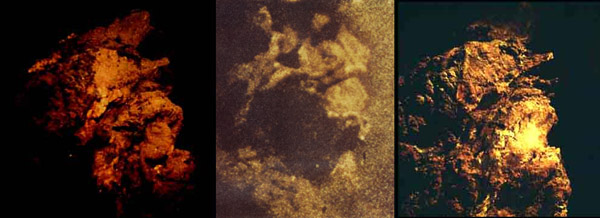
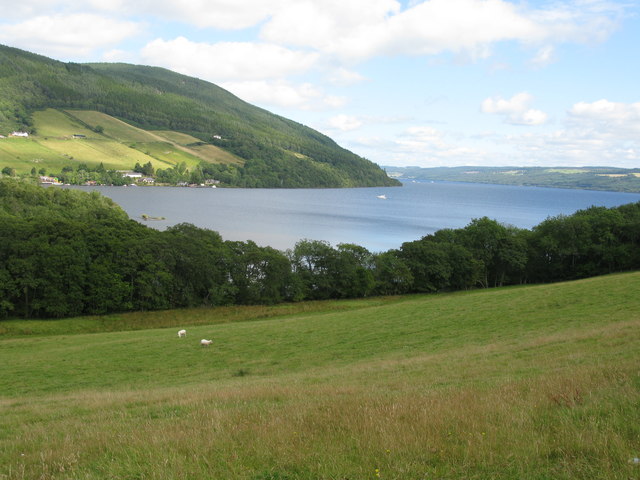
There is nothing odd about a stump lying there. The rivers Enrick and Coiltie both run into Urquhart Bay through an alder wood that floods every year, and the bay floor collects what they carry down. It is the same bay that dominates the sightings heatmap.
Was that it?
Two questions tend to get run together. One is whether the 1975 frame shows an animal. The other is whether this particular stump is the thing in the frame. The second can be doubted without reviving the first.
The case that the stump is the gargoyle
- It was found by prediction. Raynor said where it should be before anyone looked, and something fitting the picture was there.
- The features correspond: one notch, projections above it, lumps below it, in the same arrangement.
- The independent evidence already pointed to a small object on the bed at close range. Harwood's shadows, the swinging rig and the neighbouring frames of the bottom all predate the find.
- Twelve years is not long for waterlogged wood in cold, dark fresh water. A stump would be expected to survive in recognisable form.
- Writers who are otherwise sympathetic to the Rines pictures accept it. Dale Drinnon, who defends the flipper and body shots, called it clearly the same stump once he had seen Raynor's photographs.
The case that it is not proven
- The match is a visual judgement. The 1975 frame is blurred, enhanced and rotated, and the stump was photographed from a different angle with a different light. Seeing a stump in the gargoyle uses the same faculty as seeing a gargoyle in the stump.
- The bay floor is covered in timber. With enough stumps to choose from, one with a notch and some stubs is not a rare find. This weakens the specific identification, though it also raises the odds that the 1975 object was wood of some kind.
- The position rests on recollection. I have not found a published fix for the 1975 mooring or for the 1987 recovery, or a depth for the stump, that would let a reader check they coincide.
- The Academy never accepted that the rig reached the bottom. Watson has argued that a drift would have begun in daylight with the team still on the loch, and that nothing similar turned up on later film when the rig was left unattended. His doubt is aimed mainly at the body picture, and he does not defend the head.
- Henry Bauer, in a 2002 paper defending the Loch Ness evidence, still listed the head as resembling a reptile and treated "rocks" and "tree stump" as critics' suggestions and nothing firmer.
The objections are fair as far as they go. What they leave standing is a possibility that the 1975 camera photographed some other piece of debris a few yards away. None of them supplies a reason to think the object was alive.
Where it stands
The gargoyle head has few defenders left. Naish treats it as pareidolia over a stump. Watson, who argues for a monster, sets it aside. The Loch Ness Centre shows the stump to visitors as the answer.
The 1975 body-and-neck picture is a different matter and still has supporters, though Raynor reads it as the same stump in silhouette. That is a subject for its own post.
So does it still lurk in the loch? The stump does not. It is on display in Drumnadrochit. The claim that it is the very object in the 1975 frame rests on a prediction that came good and on a likeness most people can see, which is strong but is not a measured match. Anyone wanting to close the gap would need the original uncropped frame in its true orientation, the film strip either side of it, and the positions of the 1975 mooring and the 1987 recovery.
The larger conclusion does not depend on that. A timed camera on a swinging rig, in a bay full of sunken timber, photographed something small at close range with no sonar contact, and the result looked like a face once it had been turned on its side. The picture tells us about the conditions in Urquhart Bay and about how readily people find faces. It does not tell us about an animal.
**Related on Loch Ness Story:** The Rines flipper photographs (1972) · Interactive sightings heatmap · Why Urquhart Bay dominates the heatmap · The Surgeon's Photograph · Sightings register
Sources
- Rines, Edgerton, Wyckoff and Klein, "Search for the Loch Ness Monster", Technology Review, March/April 1976. The Academy's own account: rig, times, measurements, expert statements, and the annotated head and body frames.
- Dick Raynor, "All at Sea with GUST", lochnessinvestigation.com. Frame-by-frame reading of the 1975 film and the stump photographs.
- Dick Raynor's comment of 15 September 2013 under "Gargoyle Face at Loch Ness", Frontiers of Zoology. The prediction, the recovery, Harwood's shadows, and Dale Drinnon's response.
- Loch Ness Centre, "Gargoyle Head". The stump's discovery, recovery and display.
- Roland Watson, "Those 1975 Underwater Photos" and the follow-up, Loch Ness Mystery blog, November 2017.
- Darren Naish, review of Gareth Williams's A Monstrous Commotion, Tetrapod Zoology, 2019. The rotation, Scott's painting, the Nature paper and the anagram.
- Loren Coleman, Rines obituary, Cryptomundo, 2009.
- Henry Bauer, "The Case for the Loch Ness Monster: The Scientific Evidence", Journal of Scientific Exploration 16(2), 2002.
- Robert H. Rines, Wikipedia, for the 1984 flipper retouching reports.
- Loch Ness Project, field research page, for the Urquhart Bay alder wood and its two rivers.
- G. E. Harwood, "Interpretation of the 1975 Loch Ness Pictures", *Progress in Underwater Science* 2, 1977, and Dennis Meredith, *Search at Loch Ness*, 1977.