Could earthquakes on the Great Glen Fault explain the Loch Ness Monster? A look at Luigi Piccardi’s theory, the loch’s thermocline, internal waves and boat wakes
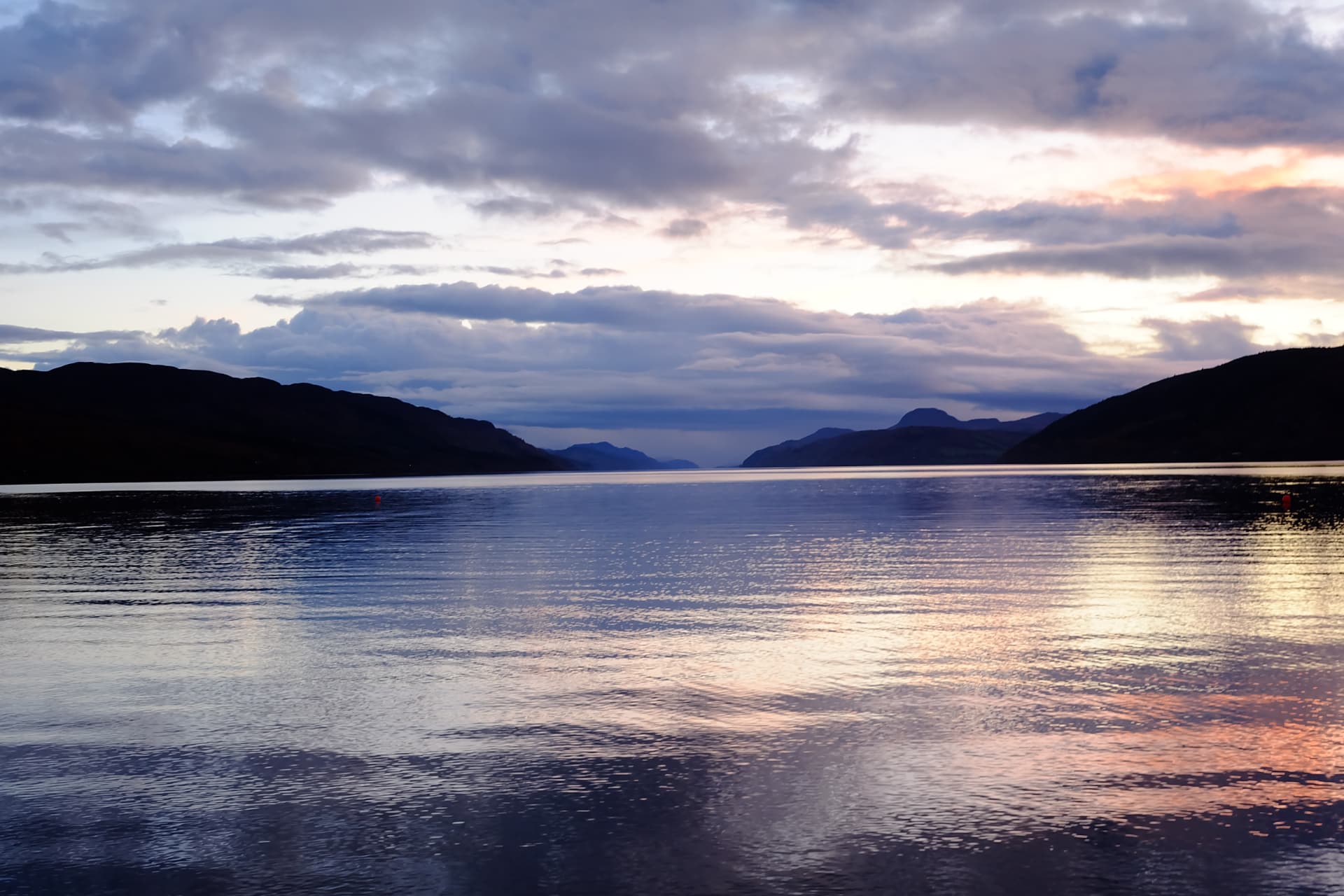
Key points
- In 2001 Italian geologist Luigi Piccardi proposed that tremors near the Great Glen Fault release gas and agitate Loch Ness, and that witnesses have mistaken these disturbances for an animal.
- The fault is real and helped shape the loch, but its present-day activity is disputed. The Inverness earthquakes of 1816 and 1901 were about magnitude 5.1 and 5.0 respectively.
- Loch Ness is about 230 m deep with a mean depth of 132 m. Its deep water stays close to 5.5°C throughout the year.
- In summer a warmer upper layer and a cold lower layer are separated by a thermocline, typically roughly 30–60 m down.
- Internal waves, boat wakes, wind, optical effects and floating objects offer physical explanations for some reports. None explains every sighting.
- Piccardi’s proposed connection between local earthquakes, gas release and monster reports remains unconfirmed.
Why look at the physics at all
Most discussion of Loch Ness sightings is about animals: what could live there, what it would eat, whether a population could survive. That approach skips a simpler question. A large proportion of reports do not describe an animal in any detail. They describe a wake, a line of humps, a patch of churning water or a sudden swell on an otherwise flat surface. Those are descriptions of water behaving unusually, and water behaviour is a physics problem before it is a zoology problem.
Loch Ness happens to be an unusual body of water. It is long, narrow, very deep, cold, steep-sided and sits along one of the major fault lines in the British Isles. Several phenomena that follow from those facts are well documented in the scientific literature, and some were first described there. This article works through them, starting with the most ambitious idea: that earthquakes are behind the monster.
The Great Glen Fault
The Great Glen runs in an almost straight line from Fort William to Inverness, cutting the Highlands in two. It follows the Great Glen Fault, a strike-slip fault where the two sides have moved horizontally past each other. The fault is at least 300 miles long and is correlated with the Cabot Fault in Newfoundland on the other side of the Atlantic. Its main movement dates back hundreds of millions of years, to the closure of an ancient ocean, and total horizontal displacement has been estimated at around 104 km.
Loch Ness exists because of the fault. Repeated movement shattered the rock along its line, and during the Ice Age glaciers exploited that weakness and gouged out a deep trench. The result is a basin with steep sides, around 1.5 km wide and up to 230 m deep. Loch Morar is deeper at its deepest point, but Loch Ness also has a remarkably large mean depth. Our Loch Ness depth and size guide sets out the measurements, and the interactive 3D loch lets you explore the basin.
Scotland is not seismically quiet, but its earthquakes are modest by world standards. The two largest events near Loch Ness were the Inverness earthquakes of 13 August 1816 and 18 September 1901. The 1816 shock brought down chimney pots and twisted the town steeple; it is usually given as about magnitude 5.1. The British Geological Survey lists the 1901 event at magnitude 5.0, at a depth of about 11 km, with an epicentre near Dochgarroch at the northern end of the loch and aftershocks continuing until November. There was a smaller Inverness earthquake in 1890.
Whether the fault is still “active” in a geological sense is not agreed. Some researchers, Piccardi among them, regard it as capable of moderate earthquakes today. Others, including BGS seismologist Roger Musson, see no sign of present movement on the main fault and attribute the 1901 earthquake to a secondary branch fault. The BGS notes that a north–south branch may have been responsible for the 1890 and 1901 sequences, and possibly 1816 as well.
Piccardi’s hypothesis
Luigi Piccardi is a structural geologist with Italy’s National Research Council in Florence. His wider field is geomythology: the idea that some myths preserve memories of real geological events. Before Loch Ness he had argued that the visions of the Oracle at Delphi could have been caused by vapours rising through a fault from hydrocarbon-bearing rock, and that the lairs of mythical dragons in the classical world tend to sit on major active faults.
In June 2001 he presented his Loch Ness version at the Earth System Processes meeting in Edinburgh, a joint conference of the Geological Society of America and the Geological Society of London. The argument had four parts.
Location. Loch Ness sits along the Great Glen Fault, and its northern end, near Inverness, is the most seismically active sector. Piccardi pointed out that most sightings also come from the northern part of the loch. Compare that claim with the sightings heatmap and our analysis of why Urquhart Bay dominates the recorded reports; a cluster alone does not establish its cause.
Mechanism. In his proposed explanation, movement on the fault releases gas from the loch bed. Gas bubbling up, together with ground shaking, produces violent commotion on the surface and waves that rock boats and slap the shore.
The witness descriptions. Piccardi said that many reports describe a loud noise, a large disturbance in the water and waves, with the animal itself hidden. Where something was seen, it was usually described as humps breaking the surface.
History. He linked the first written account, in Adomnán’s Life of St Columba, to an earthquake, which he called the “St Columba earthquake”, placing it on the fault between Loch Ness and Inverness. He also suggested that the 1920s and 1930s, when reports multiplied, was a period of increased fault activity.
The diagram below sets out the chain of cause and interpretation the hypothesis relies on. Its earthquake marker represents documented regional earthquakes, not proof of present movement on the main fault.
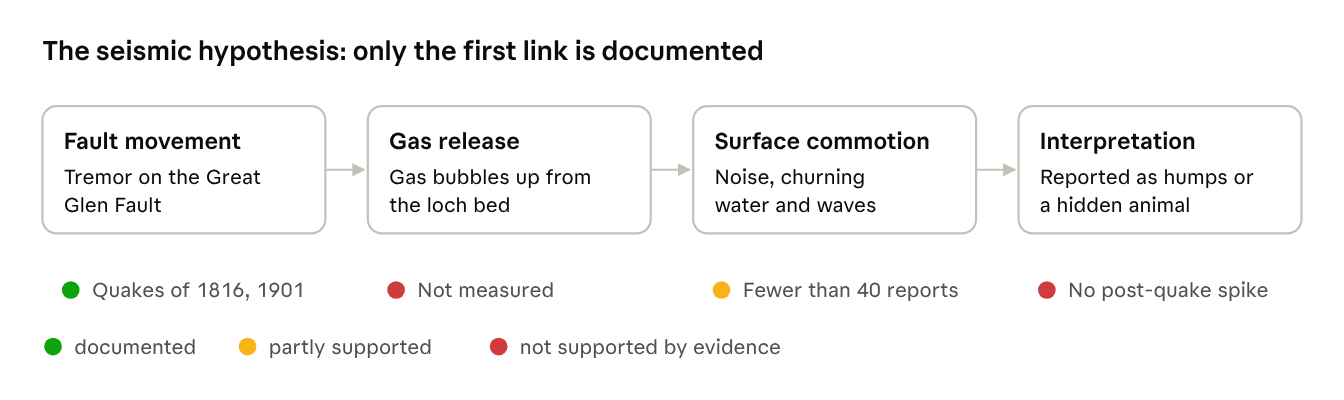
Every link has to hold for the explanation to work. The evidence for each is marked underneath it.
Problems with the seismic explanation
The hypothesis drew wide press coverage in 2001, but it has several weaknesses, and Piccardi did not claim it explained every report.
The sample was small. By the time of the conference there were more than 3,000 recorded sightings. Piccardi’s analysis reportedly drew on fewer than 40 of them, selected for their descriptions of noise and commotion.
Sightings do not cluster around known earthquakes. Adrian Shine of the Loch Ness Project responded at the time that “monster sightings are not restricted at times of seismic activity”. Most reports come on calm days with no felt tremor, and there is no recorded spike in sightings after 1816, 1890 or 1901.
The earthquakes may not produce the proposed effects. A magnitude 5 shock is felt over a wide area and can damage chimneys, but that does not establish that it would churn the loch or release gas in the way proposed. The specific chain of effects needs evidence, not simply the existence of earthquakes in the region.
The 1930s surge has a better explanation. The rise in reports from 1933 coincides with improvements to the A82 along the north shore, which gave motorists better views of the loch, and with sustained newspaper coverage. Piccardi’s comments about increased fault activity in the 1920s and 1930s were not tied to a cited earthquake catalogue.
The St Columba story is not obviously seismic. In Adomnán’s account, written in the late seventh century, the St Columba encounter happens at the River Ness, not the loch, and the beast attacks a swimmer and retreats when Columba invokes God. Reading an earthquake into it depends on how much weight is put on the descriptive language, and the story belongs to a genre of saints’ lives in which saints routinely face down beasts.
There are no instrumental records establishing the proposed gas release. The case rests on the wording of witness reports and historical texts. Sonar and survey work on the loch over several decades has not identified fault-related gas venting as a recurring explanation for sightings.
Piccardi’s own view, as reported at the time, was that the value of the idea lay less in solving Loch Ness than in making geologists take the geological origins of myths seriously. Shine, for his part, said it was useful that the loch’s fault-line origins had been brought to public attention.
Seismic seiches: the part that is documented
One version of the earthquake idea does have a solid historical record, though it is different from Piccardi’s local gas-release hypothesis.
On 1 November 1755 a very large earthquake destroyed Lisbon. Lakes across Britain began to oscillate. The Scots Magazine reported unusual movement on Loch Lomond, Loch Long, Loch Katrine and Loch Ness. These accounts are early published descriptions of what are now called seismic seiches: standing waves set up in enclosed water when seismic waves pass through. At Fort Augustus the level of Loch Ness reportedly rose by about two feet, fell back, and rose again.
This shows that seismic energy can visibly move the water in Loch Ness. In this documented case, the source was a large, distant earthquake, whose long-period waves could excite the natural oscillation of the basin. It is not evidence for Piccardi’s proposed local gas-release mechanism. No monster was reported in the cited 1755 account: the descriptions concern water-level changes, not an animal.
The same principle applies on a smaller scale without any earthquake. Any long, narrow lake has a natural surface seiche: wind or a pressure change piles water at one end, and when the forcing stops the surface rocks back and forth along the length of the basin. On Loch Ness the vertical movement of the surface seiche is small and slow, and it would rarely be noticed by someone on the shore. Its counterpart below the surface is much larger.
How Loch Ness is layered: epilimnion, thermocline and hypolimnion
Water is densest at about 4°C. Above that temperature, warmer water is lighter and floats on cooler water. In a deep temperate lake this sets up a seasonal structure.
- Epilimnion: the upper layer, warmed by the sun and mixed by the wind, with a fairly even temperature from top to bottom.
- Thermocline, or metalimnion: a band where temperature falls quickly with depth. It limits exchange between the upper and lower layers.
- Hypolimnion: the cold, dense water below the thermocline. In Loch Ness it is very large and stays close to 5.5°C throughout the year.
In Loch Ness the loch typically becomes stratified in late June. Because the basin is so large and so exposed to wind along its length, the summer thermocline is deep, roughly 30–60 m, and is often eroded and pushed around by wind mixing. The surface water itself ranges approximately between 5°C and 13°C across the year. In autumn the epilimnion cools, the thermocline sinks and weakens, and by spring the loch has mixed back towards a uniform temperature of about 5.5°C.
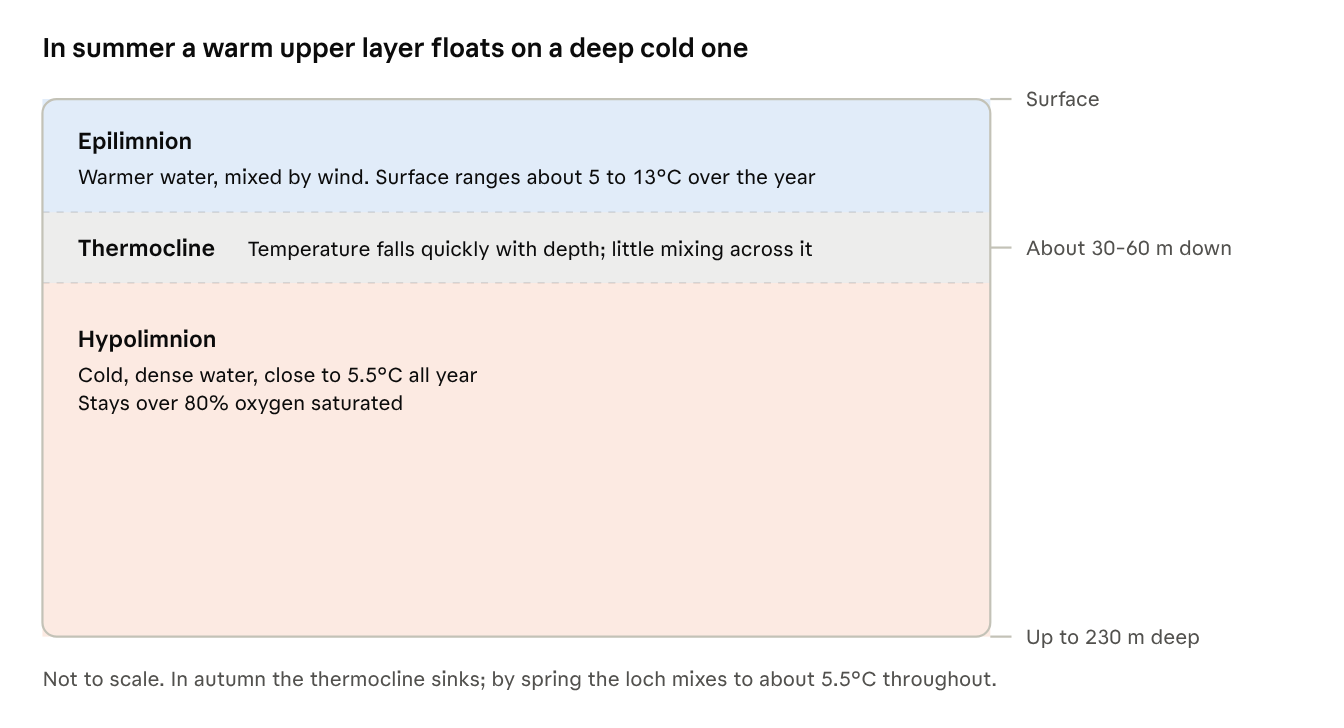
The two main layers exchange relatively little water until autumn cooling breaks the structure down. The enormous reservoir of deep water helps explain why Loch Ness does not normally freeze. In very cold weather the relatively warm surface produces steam fog over the water. The hypolimnion also stays well oxygenated, reported at over 80% saturation, because the loch is nutrient-poor and little organic matter decays in the deep water.
Internal seiches and the internal surge
Because the upper and lower layers have different densities, the thermocline behaves like a second surface inside the loch. It can carry waves of its own, and because the density difference across it is small compared with the difference between water and air, those waves can be very large and very slow.
Loch Ness played an important role in the early scientific description of these waves. In 1903–04 E. R. Watson noticed regular temperature swings in the deep water and proposed that the thermocline was rocking back and forth along the loch. E. M. Wedderburn confirmed it in 1907 with continuous temperature recordings and laboratory tank experiments. Their work helped establish that large bodies of water contain internal waves, and Loch Ness has been a standard site for internal-wave research ever since.
The mechanism is straightforward. A sustained wind along the loch pushes warm surface water towards the downwind end. The surface there rises by a few centimetres, but to balance it the thermocline is pushed down by a much larger amount, and it rises correspondingly at the upwind end. When the wind drops, the tilted thermocline swings back and keeps oscillating around a midpoint, like water rocking in a bath. This is the internal seiche.
Later work by Steve Thorpe and colleagues found that in Loch Ness a large internal seiche can steepen into an internal surge, a moving front with a train of waves behind it that travels the length of the loch, reflects, and comes back, sometimes keeping its strength for several cycles.
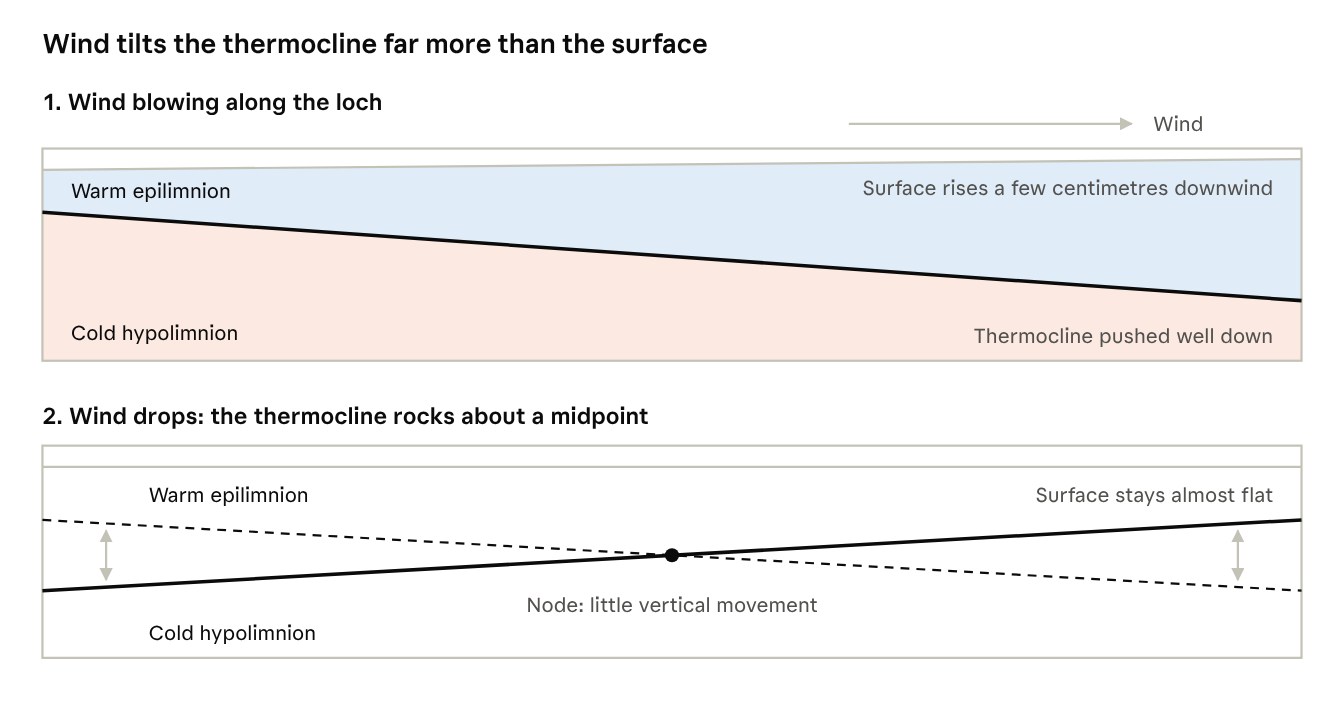
The surface moves by centimetres. The thermocline beneath it moves by far more, largely out of sight.
Can this be seen from the shore? Mostly not directly. The movement at the surface is tiny compared with the movement at the thermocline. But internal waves do interact with surface waves. Where an internal wave moves beneath the surface it changes the surface currents slightly, which smooths or roughens small ripples. On calm days this can produce bands or lanes of glassy or textured water moving across the loch with no visible cause. To an observer expecting an animal, a slick advancing against the wind is a candidate for something moving just below.
Internal waves also bear on sonar. Temperature gradients change how sound travels, and thermocline waves and billows, which Thorpe and Hall recorded in Loch Ness in 1974, can affect the interpretation of mid-water returns. The Loch Ness Project has long listed thermal effects alongside fish shoals and boat wakes as considerations in interpreting sonar contacts. This is relevant to the echoes discussed in our Operation Deepscan 1987 case study, but does not identify the cause of any individual unexplained contact.
Boat wakes and standing waves
One of the most common physical explanations for hump sightings is the boat wake, and the reason is specific to the shape of the loch.
An object moving through water produces a displacement wake. The classical deep-water Kelvin wake has two outer arms spreading out in a V at roughly 39 degrees between them; actual visible wake angles vary with speed, depth and the vessel. Each arm is made of a series of individual waves. Seen from the side and from a low angle, the crests can look like a line of dark humps moving in formation, the classic multi-humped form of the monster. On a calm loch these waves can travel a considerable distance and persist after the boat has passed out of sight.
Loch Ness makes this more complicated in two ways. First, it is narrow with steep sides, so a wake from a boat in mid-loch reaches both shores at nearly the same time, reflects, and meets itself again in the middle. Where wave trains cross, they can add together into a larger, isolated wave that appears to hold its shape and move independently. Shine and others have called these “standing waves”, though the term is used loosely and not in the strict physics sense. Second, the loch carries regular traffic from the Caledonian Canal, including heavier vessels, and on a busy day several wake systems can be crossing at once.
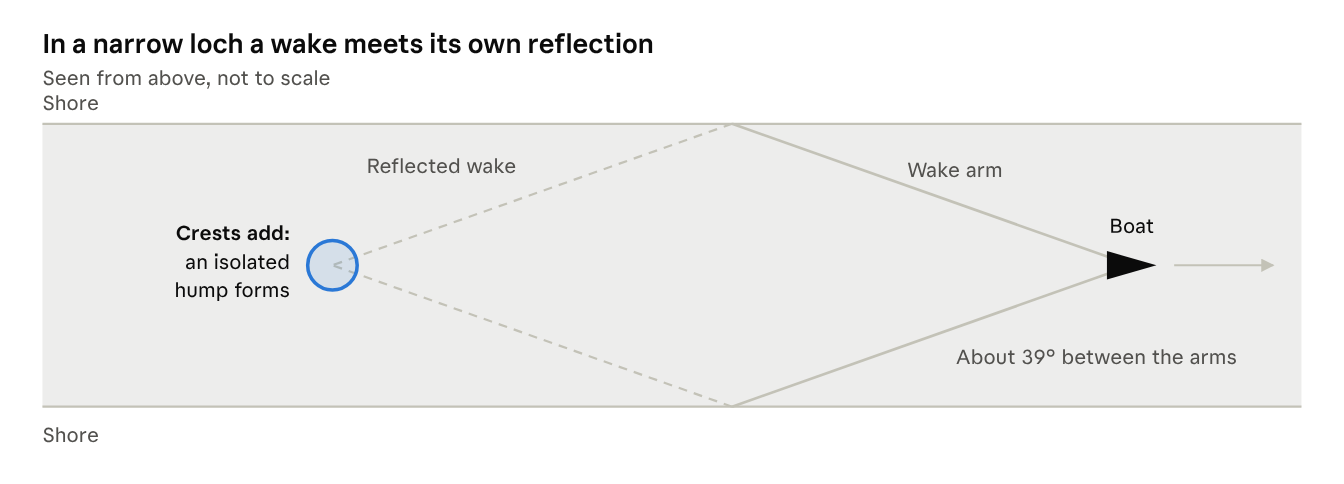
By the time reflected wakes meet, the boat that made them may be well out of view. Both effects are easiest to recognise on a flat calm surface. That is why monster weather and wake weather often overlap. Investigators including Adrian Shine and Dick Raynor have matched a number of well-known photographs and films to wakes, and a 2023 article by Steuart Campbell in The Skeptic reviewed historical reports that fit the pattern.
Wind on a sheltered loch
The hills either side of Loch Ness shelter much of the surface, but because they are high and irregular they also break up the wind. Gusts come down off the slopes in patches and strike the water locally. On an otherwise calm day this produces dark, ruffled patches that appear suddenly, move across the surface and vanish. Shine has described these “flaws” as a recurring source of reported disturbances.
When the prevailing wind blows along the glen, waves reflect the sky and give the loch a light, even grey. Anything that interrupts that pattern, such as a cats-paw of wind, a wake or an interference crest, stands out as a dark shape.
Floating logs and gas
A different gas mechanism from Piccardi’s was put forward in New Scientist in 1982. Scots pine is heavily resinous. In this hypothesis, a pine trunk that sinks to the cold floor of a deep loch decays slowly, and resin can seal gases produced by decay inside the wood. Eventually pressure ruptures the seal, and the log can rise abruptly, possibly broken-ended and trailing bubbles, before settling back. A log with branch stumps rising to the surface in a burst of gas would match some descriptions of a head-and-neck or a creature surfacing and diving.
The argument drew support from the association of Scottish monster traditions, including Ness and Morar, with native pinewoods, and reports of beached pine logs showing signs of deep-water fermentation. It works best as a possible explanation for brief, close-range sightings of something emerging and disappearing, and has been criticised when applied to specific photographs. It is a hypothesis about decaying wood, not evidence for gas venting from the Great Glen Fault.
Optical effects
Several optical factors affect what people see on the loch, especially at distance.
Lack of scale. Open water has no fixed reference points. Without them the eye has no reliable way to judge size or distance, so a bird, a wave crest or a log can be read as something much larger and further away.
Refraction and mirage. The loch’s water is cold for much of the year. When warmer air sits over colder water, light bends through the temperature gradient, which can lift, stretch or stack distant objects. Boats, rocks and birds near the opposite shore can appear distorted or raised clear of the water.
Dark water. Loch Ness water is stained by peat washed in from the catchment, and visibility falls to a few metres. Anything just below the surface is effectively invisible, so observers see only what breaks the surface: a wake, a hump, a splash.
Birds. A group of waterbirds taking off and landing in sequence leaves a line of wakes that can look like something surfacing repeatedly. Dick Raynor has suggested this as a possible explanation for his own 1967 film.
Steam fog. In cold winter weather the loch’s surface is much warmer than the air above it and gives off drifting columns of vapour, sometimes called sea smoke. In poor light these columns can take on shapes over the water.
Which explanation fits which kind of report
None of these mechanisms is a complete answer, and they apply to different kinds of report. The following are possibilities to investigate, not identifications of particular sightings.
| Type of report | Possible physical explanations | Conditions |
|---|---|---|
| Line of humps moving in formation | Boat wake arms; interference waves | Flat calm; boat recently passed, possibly out of sight |
| Single large wake with no visible source | Persisting wake; internal wave slick; birds | Calm; good light |
| Sudden churning or boiling patch | Wind flaw; birds; rising log with gas; Piccardi’s fault gas, unconfirmed | Variable |
| Object rises, then sinks | Gas-filled log; diving bird | Close range |
| Water level rises and falls along the shore | Seismic seiche, documented in 1755; surface seiche | Distant large earthquake; strong wind change |
| Shape distorted or lifted above the water | Refraction over cold water | Long range; temperature contrast |
| Mid-water sonar contact | Thermocline effects; fish shoals | Summer stratification |
Piccardi’s specific claim, that local earthquakes on the Great Glen Fault release gas and create the disturbances people interpret as a monster, is among the weakest-supported explanations on this list. The fault is real, it shaped the loch, and the region has had damaging earthquakes. But the known earthquakes do not line up with sightings, the proposed gas-release mechanism has not been measured, and the documented seismic disturbance from Lisbon in 1755 produced descriptions of water-level changes rather than a monster.
The more useful lesson is that geology and physics explain a good deal about why people see things on Loch Ness. Internal waves, wakes and refraction are not exotic. They are well-studied and, in the case of internal waves, have a long history of research on this loch. Witnesses who report humps on a flat calm morning may be accurately describing something real that the water was doing. The question is what produced it.
Sources
- ABC News: A New Explanation for Loch Ness Monster? (27 June 2001)
- Scientific American: Could a Seismic Fault Account for Loch Ness’s Mysterious Monster?
- Scientific American: The Earth-shattering Loch Ness Monster that wasn’t
- Science News: Is Nessie merely a bad case of the shakes?
- CBS News: Nessie: Hot Air Or The Real Thing? — Adrian Shine’s response
- Irish Times: Quakes may explain Nessie, says expert
- British Geological Survey: Inverness earthquake, 18 September 1901
- BGS Earthwise: Seismicity of the Northern Highlands
- Great Glen Fault: background and references
- USGS: Seismic Seiches
- Loch Ness Project: Underwater Loch Ness
- Loch Ness Project: The Thermocline and Underwater Waves
- Shine and Martin: Loch Ness Habitats Observed by Sonar and Underwater Television, The Scottish Naturalist (1988)
- Thorpe: Turbulence and mixing in a Scottish Loch (1977)
- Thorpe and colleagues: Near-resonant forcing in a shallow two-layer fluid — a model for the internal surge in Loch Ness?
- Heald and colleagues: zooplankton and fish distribution in Loch Ness
- Adrian Shine: Mistaken Monsters, part 1
- Adrian Shine: Mistaken Monsters, part 2
- Steuart Campbell: Wave good bye to Nessie, The Skeptic (2023)
Explore the evidence
Compare the descriptions in the Loch Ness sightings register with the physical explanations above. The Peter MacNab photograph case file examines a famous surface image, while the Rines flipper photographs explore the different challenges of interpreting underwater evidence.