Operation Deepscan 1987: What Did the Loch Ness Sonar Search Find?
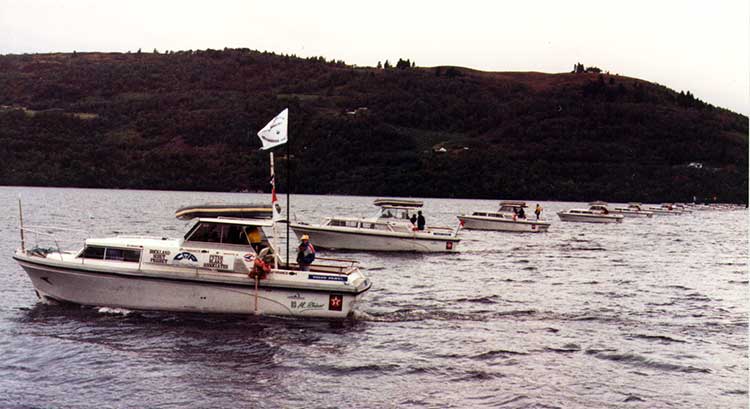
On 9 October 1987 a line of hired cabin cruisers moved south down Loch Ness, each running an echo sounder pointed at the bottom. The exercise was called Operation Deepscan. It was devised and led by Adrian Shine of the Loch Ness and Morar Project, its main sweeps took two days, and at the time it was the most extensive search of the loch ever attempted.
It is usually summarised in one line: 24 boats, £1 million, three unexplained contacts. Each part of that line needs qualifying. The boat count varies by source, the £1 million was never spent as a cash budget, and the three contacts were not equally good. This post sets out what was planned, what it cost, who took part, what was recorded, and how the results have been read since.
Photograph above: the Deepscan fleet in line across Loch Ness, 1987. Credit: Loch Ness Project archive. View the original archive.
Background: sonar at Loch Ness before 1987
Deepscan was not the first sonar search of the loch. It was an attempt to settle a problem that earlier sonar work had created.
In December 1954 the fishing boat Rival III recorded a large object at 146 m that appeared to keep pace with the vessel. In 1962 a Cambridge expedition ran echo sounders along the loch. In 1968 Professor D. Gordon Tucker of Birmingham University fixed a prototype sonar at Temple Pier in Urquhart Bay and recorded targets that seemed to move faster than fish shoals. In 1972 and 1975 Robert Rines and the Academy of Applied Science combined sonar with underwater strobe cameras and produced the flipper photographs and gargoyle head photograph. A summary of these earlier searches is on Wikipedia.
None of this was conclusive, but it left a pattern. Sonar teams kept reporting occasional strong echoes in deep water that they could not identify.
Adrian Shine had begun at Loch Morar in 1973 and moved his work to Loch Ness in the mid-1970s (see our profile of Shine). By the 1980s his Loch Ness and Morar Project was running volunteer sonar patrols. The key season was 1982. Between May and August two scanning sonars logged more than 1,500 hours of day and night patrols, mostly over the deep northern basin, and recorded 40 contacts of interest. Most lay below the layer where the loch's fish are found, and some were stronger than the echo expected from a one-metre fish. In 1984 a moored raft over 190 m of water recorded 106 moderate contacts, but none as strong as those of 1982. The figures are from Shine and David Martin's paper in The Scottish Naturalist.
The weakness of this work was known to the people doing it. A single patrol boat could find a strong contact but could not show whether it was moving. A waterlogged log tethered in mid-water, or a piece of debris on a line, would give a strong echo in the same place every time. A boat passing once could not tell that from an animal. Deepscan was designed to remove that ambiguity by finding the strong contacts, fixing their positions, and going back.
The plan
The Scottish Naturalist paper lists three objectives. The first was to search the deep basins for strong contacts, fix their positions, and revisit them to test whether they were tethered debris. The second was to chart objects on the loch bed so they could be inspected later by underwater television or submersible. The third was to continue the Project's existing work on deep-water life and autumn fish distribution.
A monster hunt is not on that list. Tony Harmsworth, then director of the Loch Ness Centre and closely involved in the organisation, wrote later that Shine expected no monster contacts. In his account the aim was to eliminate sources of error and to find better ways of deploying cameras. He adds a specific secondary aim: to find the object on the bed of Urquhart Bay that had produced Rines's 1975 gargoyle head photograph. Dick Raynor knew roughly where it was.
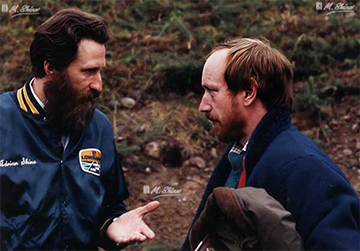
Photograph source: Loch Ness Project’s Operation Deepscan archive.
The method
The idea was a sonar curtain. A row of boats would move down the loch in line abreast, each with an echo sounder looking straight down, so that the cones of sound overlapped at depth. It was intended to make deep-water targets harder to miss, rather than cover every part of the loch at every depth.
The boats were motor cruisers from the Caley Cruisers hire fleet in Inverness. The sounders were Lowrance X-16 units, a paper-chart fish finder, run on their 50 kHz setting with 30-degree transducers. The paper record was important because every boat would come back with a physical trace that could be checked.
The procedure was simple. Any contact below 30 m, or on the bed, was radioed to a flagship and a marker buoy was dropped. Follow-up vessels with sonar engineers aboard then tried to hold the contact until the motor cruiser New Atlantis arrived. New Atlantis carried better equipment: a Simrad EQ100 sounder to measure echo strength, a Simrad SY scanning sonar to track a target, and a Decca Navigator with a Racal Decca video plotter to fix the position. The position would be revisited later. A contact still there was fixed. A contact that had gone was not.
The 1986 trial
A trial was run in October 1986. It exposed the main technical problem, which was that sounders working side by side interfere with each other. The solution was to stagger the pulse rates along the line, and the cost of that was reduced sensitivity. High winds cut the trial short and no contacts of interest were obtained. The full operation was put back a year.
The schedule
The paper gives the dates of the full experiment as 4 to 14 October 1987. From 4 to 8 October the fleet ran training sweeps in the northern basin. The two full sweeps of the deep basins took place on Friday 9 and Saturday 10 October, with a smaller flotilla working on the Sunday.
The publicity plan
There was a second plan running alongside the scientific one. Harmsworth describes the arrival of John Fenn, a public relations consultant for Lowrance Electronics, who promoted the event as the biggest monster hunt ever staged and as the final one. A plesiosaur appeared on the operation’s logo. The bookmaker William Hill was reported to be offering 250 to 1 against the monster being found (The Press, 23 September 1987).
Shine set out the scientific objectives at a press conference on 17 September, and according to Harmsworth he refused to wear the Deepscan jacket because of the plesiosaur on it. The gap between what the organiser intended and what the press had been told to expect shaped how the result was reported.
The cost
Deepscan is almost always described as a £1 million operation. According to Harmsworth’s recollection, the actual cash cost was about £10,000.
The £1 million figure, and the $1.6 million quoted by UPI at the time, is a valuation of the equipment on the water, not a budget. The BBC’s report said £1 million worth of equipment was used, which is accurate as far as it goes. Over time “£1 million of equipment” became “cost £1 million”.
Harmsworth gives the clearest account of where the number came from, in the second part of his Deepscan chapter. The organisers had not published real costs, so journalists worked out their own. He questioned one writer who had printed £1.25 million and was given the arithmetic. Almost all of it was the replacement value of the boats.
| Item | How the press valued it | What actually happened, according to Harmsworth |
|---|---|---|
| 25 cruisers | £50,000 each, £1.25 million in total | Lent free by Jim Hogan of Caley Cruisers |
| 25 echo sounders | £500 each, £12,500 | Lent free by Lowrance Electronics |
| 2 scanning sonars | £5,000 each, £10,000 | Already owned by Hogan and the Project |
| Crews | £100 per person per day | Volunteers |
| Fuel | £20 per day | Sponsored by Volvo Penta |
| Food for about 100 people | £10 per day | Paid for |
What was left was food and logistics. Harmsworth puts this at about £10,000 and says it was covered by a grant from the Highlands and Islands board. He calls it the Enterprise Board; in 1987 the body was the Highlands and Islands Development Board, which is the name thanked in Shine and Martin's acknowledgements. UPI also listed the Scottish and British tourist boards among the sponsors.
Two points follow. First, Deepscan was cheap because it was built on loans and volunteers, which was how the Loch Ness and Morar Project had always worked. Second, the sponsors got good value. Lowrance had its fish finders on television worldwide, and Harmsworth's estimate of the tourism benefit to the area is in the millions. That figure is his opinion and is not documented.
Those involved
Deepscan needed more than a hundred people on the water and ashore. The names below are those that the sources allow to be tied to a specific role.
| Name | Role |
|---|---|
| Adrian Shine | Leader of the Loch Ness and Morar Project. Devised and directed the operation and gave the press briefings. |
| David Martin | Project member and co-author with Shine of the Scottish Naturalist paper containing the formal Deepscan report. |
| Darrell Lowrance | President of Lowrance Electronics of Tulsa, Oklahoma. Supplied the X-16 sounders, brought his own engineers and was present throughout. |
| John Fenn | Lowrance’s public relations consultant. Responsible for much of the biggest-monster-hunt publicity. |
| Jim Hogan | Owner of Caley Cruisers, Inverness. Lent the fleet, including the sonar-equipped New Atlantis. |
| Tony Harmsworth | Director of the Loch Ness Centre at Drumnadrochit. Handled press accommodation and logistics. |
| Ronnie Bremner | Owner of the Loch Ness Centre and of the Clansman Hotel, the operation’s base. |
| Dick Raynor | Long-standing loch researcher. Photographed being briefed by Shine, and knew the approximate position of the Rines gargoyle-head target. |
| Steve Ravenhill | Volunteer crew on New Atlantis. Did much of the driving and scanning sonar work, and later gave a detailed interview. |
| Jane Shine | Took the Deepscan photographs used in the published report. |
Ravenhill’s account can be read in his 2019 interview with Beasts of Britain.
Behind these were the volunteer crews. The Project’s acknowledgements thank contingents from cadet forces, the Sea Cadets, Venture Scouts, the Fort George Volunteers and two services sailing clubs for its fieldwork through the decade. Simrad lent sonar and expertise, Racal Decca the plotting equipment, and Volvo Penta paid for the fuel.
The press were a group in their own right. Accounts give about 250 journalists and 20 or more television crews. The Loch Ness Project’s own figure is over 23 international TV crews. Harmsworth lists CNN, the BBC, ITN and Channel Four among them, and records that a Japanese crew was pulled off the Conservative Party conference to cover it. Staff from Inverness Tourist Information ran the press centre, and coaches shuttled reporters between Inverness, Drumnadrochit and Urquhart Castle.
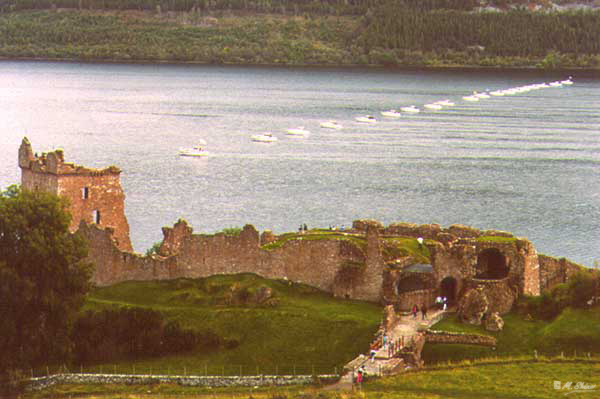
Photograph source: Loch Ness Project archive.
The operation: how many boats?
The figure in most accounts is 24. UPI reported 25. The Loch Ness Project website says 20. The published paper says the two full sweeps were made by 19 vessels with X-16 sounders.
These are not really in conflict. Nineteen boats formed the line. Behind them came follow-up vessels with sonar engineers, New Atlantis, and the flagship. Twenty-four or 25 is the working fleet. Harmsworth counted about 30 boats in the Clansman harbour once press boats were included.
Friday 9 October
The fleet assembled at the Clansman Hotel harbour on the north shore. Harmsworth describes over a hundred volunteers and officials, a lunch of haggis and sausages, and Shine sending the crews off by megaphone. UPI's report from the day describes bright sunshine and a brisk southerly wind raising whitecaps.
The line formed up and moved south towards Fort Augustus, the boats holding station on flags. The published spacing was about 45 m between vessels. The sweep was planned to take six or seven hours. At one point, according to the day-by-day accounts, a fishing trawler coming up the loch broke through the line.
Three contacts of interest were logged that day, at 78 m, 171 m and about 174 m. The third and strongest was off Whitefield, on the eastern side of the northern basin opposite Urquhart Bay. They are examined below. That evening's debriefing reported them to the press, and Darrell Lowrance supplied the line that has been quoted ever since, that the contacts were “larger than a shark but smaller than a whale” (as reported by nessie.co.uk).
Saturday 10 October
The line re-formed near Fort Augustus and swept north as far as Abriachan. Before it started, Shine sent five boats in an extra line to the plotted position of the strongest contact. They found nothing. The main sweep passed over the same ground later and also found nothing. Apart from a few indistinct traces, the second day produced no contacts to match the first.
That night Shine faced a press conference of about 200 people. He told them there were strong sonar contacts in Loch Ness but that he did not think they amounted to what he called the “media monster”, meaning the long-necked reptile of the postcards. UPI recorded the reaction. Harmsworth said at the time that Shine was being overcautious on limited data. Ronnie Bremner said he still believed in the monster. A local man, Donald MacKinnon, who reported a sighting of his own in 1979, said the boats had not covered the full width of the loch.
After the main sweeps
A smaller flotilla worked on Sunday 11 October. On 12 October a small group of boats picked up a contact over the western side wall, outside the main sweep area. It was found again that evening in the same place and was logged as fixed.
By then most of the press had gone. Several outlets reported the operation as a failure, on the grounds that no monster had been produced.
The findings: the three contacts
All three were recorded on 9 October during the north-to-south sweep. The details below are from the Deepscan supplement in Shine and Martin’s paper.
| Contact | Depth | Strength | Details from the published report |
|---|---|---|---|
| 1 | 78 m | Moderate | Mid-water, well below the fish layer. |
| 2 | 171 m | Strong | The authors say interference from returning echoes cannot be ruled out. |
| 3 | About 174 m | Strong | Picked up by a follow-up vessel just behind the line, which had not recorded it. The vessel stopped and turned, and the contact appeared to cross near the centre of the beam. New Atlantis did not regain it. A Decca position was taken. |
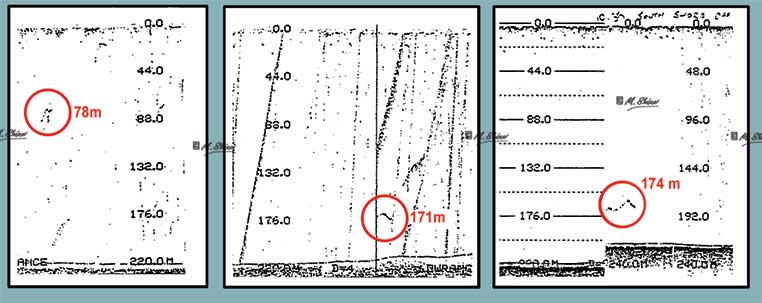
Original sonar-chart comparison: Loch Ness Project.
Popular accounts usually give the range as 78 to 180 m and describe the deepest as “at 600 feet”. The published depths are slightly shallower, but the difference is not important.
The critical fact about all three is that they were not there when the positions were revisited. Under the logic of the experiment that puts them in a different class from tethered debris.
The fixed contacts
Most of the contacts marked during the operation were still in place when the boats went back. These were followed up in July 1988, when the fixed positions were relocated and inspected with a Sutec Sea Owl remotely operated vehicle. It found discarded rope and a piece of scientific instrumentation.
This was a real result, though it made no headlines. It showed that tethered or snagged debris does exist in the loch and does give strong repeatable echoes. The paper also notes that no such debris was found between Foyers and Urquhart Bay, where the strong 1982 contacts had been recorded.
The gargoyle head
The search of Urquhart Bay for the source of Rines's 1975 gargoyle head photograph produced a physical object. The Loch Ness Project's timeline records that a sunken tree stump was recovered during Deepscan from beneath the position where the Rines camera rig had been moored, and that it closely resembles the photograph. A Cryptomundo account credits Dick Raynor, diving, with photographing the stump and bringing it up in October 1987.
The stump was kept and went to the exhibition at Drumnadrochit, where it has been reported on display for some years. In July 2026 the centre, rebranded as the Loch Ness Experience, announced it again among a group of artefacts being put before visitors, alongside a 1970s camera that belonged to Roy Mackal.
The identification is widely accepted. Ravenhill, who was aboard New Atlantis, regards the photograph as having been debunked by the operation. It is not accepted by everyone. Henry Bauer, who attended the press conference at which Shine presented the stump, has written that those present were surprised that a likeness was being claimed at all (quoted in this review paper). See our gargoyle head article for the photographs and comparison.
What was not found
No contact of the size implied by the classic sighting reports was recorded. The Loch Ness Project's summary is that the contacts were stronger than fish and much deeper than fish, but were not ten-metre monsters.
The paper is candid about the limits of that negative. Because sensitivity had been turned down to control interference, some moderate targets already known to the Project were not recorded by the line at all. The combined track of all vessels over the training and full sweeps is given as more than 3,651 km, and no other trace like contact 3 appears on any of the charts.
Reading the contacts
The three contacts have been claimed by both sides of the argument for nearly forty years. The cases are set out here without a ruling.
The case that they were something unusual
- Depth. The loch’s open-water fish are found mostly in the top 30 m. Two of the contacts were at about 170 m, in water with very little in it.
- Strength. Two were classed as strong. The Project’s earlier calibration work had found deep contacts several decibels above the echo expected from a one-metre fish.
- They moved, or at least went. None was there on the return visit, which is the test the experiment was built around. Contact 3 also appeared to cross the beam while the boat was stationary.
- The sonar men were surprised. Lowrance and his engineers handled fish-finder traces for a living. UPI reported him saying he believed there was something deep down that was bigger than a fish.
- They fit a pattern. Birmingham in 1968, the Project in 1982 and Deepscan in 1987 used different equipment and all reported occasional strong deep-water targets.
The case that they were ordinary
- There were only three. Nineteen boats over two full sweeps and several training days produced three contacts, on one day.
- Each has a weakness. Contact 1 was only moderate. The authors themselves say contact 2 may have been interference. Contact 3 was recorded by one vessel, was missed by the line that had just passed over it, and was not confirmed by New Atlantis.
- Seals. Seals enter Loch Ness from the sea, and the Loch Ness Project says they are now known to do so almost every year. Lowrance himself told UPI by the end that he leaned towards a seal. Shine has also suggested seals on grounds of size.
- Debris and physics. The paper lists boat wakes, thermal effects, side echoes and sinking logs as known sources of false contacts. Darren Naish, writing for BBC Science Focus, thinks debris or thermal effects most likely, with a seal as a possibility.
- Nothing since. Later sonar work, including the BBC’s 2003 survey with 600 beams, has not produced a large animal. The 2018 environmental DNA survey found no reptile DNA; see our article on Neil Gemmell’s DNA experiment.
Where each case runs into trouble
The seal explanation is the one most often repeated, and the Loch Ness Project's own page points out the difficulty with it. There is no food at 170 m, and an air-breathing animal has no reason to be there. The 2018 DNA survey also found no seal DNA, although a seal that visited in 1987 would not be expected to leave a trace 31 years later.
The sinking log is considered in the paper for contact 3. The authors' own comment is that a slowly sinking log should have been found again on the bottom, and it was not.
The animal reading has a different problem, which is food. The follow-up acoustic survey estimated the loch's open-water fish stock at about 20 tonnes. That is a small larder for a population of large predators.
Criticisms of the operation itself
People who think there is an unknown animal in the loch have argued that Deepscan could not have found it anyway.
- Coverage. The line did not reach from shore to shore. Nineteen boats at 45 m spacing make a line roughly 800 m wide, and the loch is about a mile wide for much of its length. The side walls, bays and both ends were left out, partly for safety. Ravenhill's estimate is that 50 to 60 per cent of the loch was covered.
- Gaps near the surface. A 30-degree beam is a cone. By simple geometry, beams from boats 45 m apart do not meet until about 84 m down, so the upper water between boats was not fully covered. This is my arithmetic from the published figures, not a statement in the report.
- Sensitivity. It was reduced to stop the sounders interfering with each other.
- Noise. Twenty engines in line may have driven anything mobile ahead of the sweep or out to the sides.
- Duration. Two daytime sweeps, with one limited night sweep, is a short sample. The paper says so.
Shine's published conclusion is narrower than either the press or his critics made it. Some contacts are exceptional in strength and depth, no link between them and surface sightings has been shown, and they merit further enquiry. The Loch Ness Project's website still describes the three contacts as unexplained. Our Loch Ness depth and size article and 3D loch model provide context for the scale of the water being searched; the modelled bed is not a measured chart of Deepscan contacts.
The importance of Deepscan in the Loch Ness story
It was the last of the big hunts
From the Mountain expedition of 1934 through the Loch Ness Investigation Bureau and the Rines expeditions, the search had been built on the idea that enough watchers or enough equipment would eventually produce the animal. Deepscan was the largest version of that idea and the last on that scale. Later efforts, such as the BBC’s 2003 survey and the 2023 volunteer search, differed in methods and organisation and did not recreate the same hired-cruiser sonar curtain.
It changed what the loch's leading investigator was looking for
The Loch Ness Project’s own account is that Deepscan cleared away the misleading contacts and left the way open for science. From 1987 to 1991 the Project worked with Simrad on Operation Echo, which inspected the fixed contacts, began mapping the loch bed with swathe sonar, and made the first acoustic estimate of the fish population. The Rosetta sediment coring project followed in 1994. By the end of the 1990s work from some 20 universities had passed through the Project’s base at Drumnadrochit.
Deepscan is the hinge between the two periods. Before it, Shine was testing whether there were large unknown animals in the loch. After it, he was studying the loch, and using the monster question as a way to get people interested in thermoclines and food chains.
It separated the monster from the contacts
Shine’s statement to the press drew a line that has held since. On one side is the long-necked reptile, which the leader of the largest search ever mounted said he did not believe in, in front of 200 journalists who had come to see it found. On the other is a small residue of strong deep-water sonar contacts that he did not claim to understand.
That distinction is why Deepscan is cited by everyone. Sceptical accounts point to the size of the search and the absence of a monster. Pro-monster accounts point to three contacts that the organisers could not explain and a sonar manufacturer who said they were bigger than fish. Both are quoting the same two days accurately.
It showed how the story gets told
Deepscan was a modest volunteer survey with a scientific brief, and it was presented to the world as a million-pound monster hunt. The £1 million figure, the 250 to 1 odds and the plesiosaur logo all came from the publicity side. When no monster appeared the event was written up as a flop, although it had done most of what its organiser set out to do.
The same gap between what an investigation tests and what an audience is told to expect recurs throughout the Loch Ness story. Deepscan is the clearest documented case of it, because both the press coverage and the technical report survive and can be compared.
It left a name
The research boat that takes visitors out from the Loch Ness Centre at Drumnadrochit is called Deepscan, after the operation.
What remains open
The three contacts of 9 October 1987 have not been explained to general satisfaction and cannot now be re-examined. They were single passes on paper charts, at reduced sensitivity, and the strongest was seen by one boat. That is not enough to support a large animal. Nor has anyone shown what they were instead.
For the physical background to interpreting echoes, read Could earthquakes on the Great Glen Fault explain the Loch Ness Monster?, which examines thermoclines, internal waves and the distinction between an unexplained sonar contact and evidence of an animal.