The most famous photo of all time? How Marmaduke Wetherell really created the Loch Ness Monster we recognise today
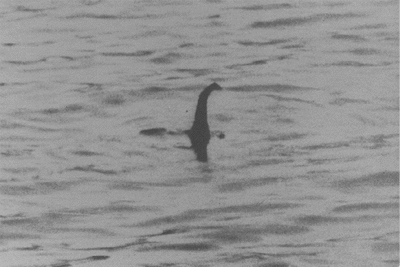
For sixty years, one photograph stood above every other piece of alleged evidence for the Loch Ness Monster. A small head on a long, curved neck rises out of rippled grey water. In the familiar crop there is nothing else to give it scale. Published in the Daily Mail in April 1934, it became known as the Surgeon’s Photograph.
The most famous photo of all time? That is a question, not a measurable ranking. But few pictures have shaped the image of Nessie so powerfully. Marmaduke Wetherell did not invent the older water-beast stories. In the widely accepted hoax account, his circle helped create the particular head and neck that we recognise today.
This article follows the supplied document, The Surgeon’s Photograph: The Story, the Players and the Unmasking, while distinguishing witness testimony, later reconstruction and remaining disagreements.
The photograph as it was presented
The Daily Mail published the photograph on Saturday 21 April 1934. The paper quoted its source as saying he took it on the Thursday, implying 19 April. Some later writers give 1 April. Publication date and claimed exposure date should not be confused.
Robert Kenneth Wilson, a London gynaecologist, said he had been driving beside the loch a few miles north-east of Invermoriston when he saw something in the water. He reportedly made four exposures, two showing something and two blank. They were developed by an Inverness chemist usually identified as Ogston’s; the clearer image was reportedly sold for £100.
Wilson did not want his name printed. That gave the photograph its nickname, although his identity soon became known. His professional standing helped lend the picture credibility. The much less familiar second photograph was published in Constance Whyte’s More Than a Legend in 1957.
The uncropped photograph: context restored
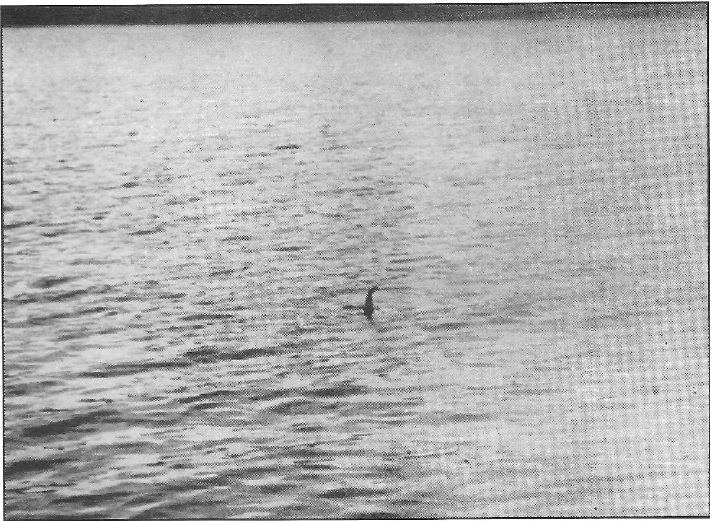
Source: Martin and Boyd, The Final Curtain, illustration 29. Their photo credits attribute the uncropped print to Illustrated London News. The complete photographic rectangle is shown here, rather than cropping around the object.
The wider picture includes much more water and the far shoreline. The object occupies a small part of the frame. That alone cannot establish its true height or distance, but it makes the missing context obvious. A head and neck against featureless water invites the viewer to supply an imagined scale.
PBS NOVA shows the cropped and uncropped versions together. Researchers used the wider picture to question earlier size estimates; seeing it is not, by itself, proof of the submarine story.
Marmaduke Wetherell: the hunter and showman
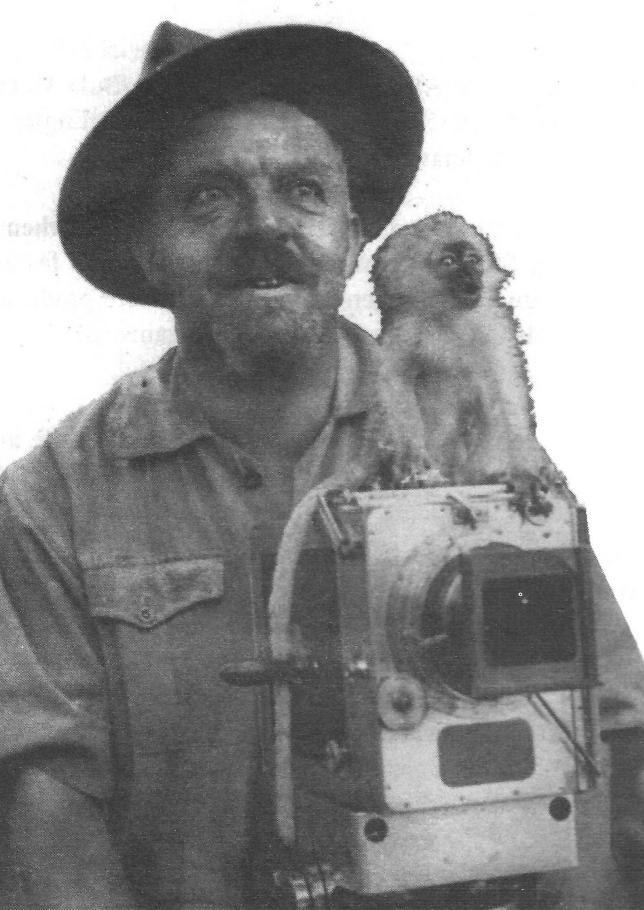
Source: Martin and Boyd, The Players, illustration 17. Photo credit: Peter Wetherell.
Marmaduke Arundel Wetherell, known as Duke, was an actor, filmmaker and big-game hunter. Sources disagree over whether he was born in 1883 or 1886; he died in 1939. His stepson Christian Spurling accompanied his Livingstone film expedition in Africa in the 1920s.
In December 1933, the Daily Mail hired Duke to investigate the monster. He announced tracks made by a large four-toed animal and sent plaster casts to the Natural History Museum. The January verdict was embarrassing: the impressions came from a dried hippopotamus foot of the sort used for trophy ashtrays or umbrella stands.
Whether Duke was fooled or knowingly made the tracks remains disputed. The later photograph-hoax account connected that humiliation to revenge against the newspaper. His family’s possession of a hippo-foot ashtray became part of Martin and Boyd’s supporting evidence.
Ian Wetherell and the forgotten newspaper column
Duke’s son Ian was a young actor in 1934. He later ran the Cross Keys pub in Chelsea and died in 1986. On 7 December 1975, Philip Purser’s Mandrake diary column in the Sunday Telegraph reported Ian describing a monster prank.
In that version, father and son drove north with a toy submarine fitted with rubber tubing. They chose an inlet where small ripples would resemble large waves, with real loch scenery behind the model. Ian said he took about five pictures. When a water bailiff appeared, Duke stepped on the model and sank it.
Ian named the insurance broker Maurice Chambers as the intended front man, not Wilson. He described a model only a few inches high and emphasised the Mail’s disappointment at finding no monster. These details do not match every part of the later account. The column attracted little attention for years, but eventually became a key investigative lead.
Christian Spurling: the model-maker
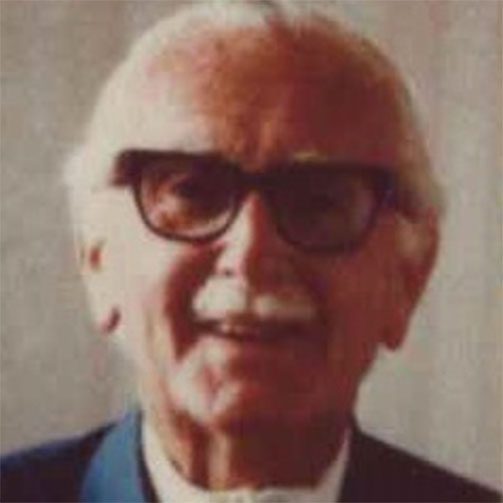
Source and credit: Christian Spurling Art, family biography. The page does not identify the photographer of this particular portrait.
Christian was Duke’s stepson and the son of marine painter Jack Spurling. His family biography gives 1902 as his birth year; older reports sometimes give 1904. Martin and Boyd’s book also uses 1902. He worked as a model-maker and later as an artist, dying in November 1993.
According to his account, Duke asked him to make a monster. Ian bought a clockwork tin submarine from Woolworths in Richmond. Christian fashioned a head and neck from plastic wood, mounted them on the conning tower and added a lead keel for balance. Later reports described a submarine about fourteen inches long and a finished model about a foot high.
Duke and Ian took it to the loch. Martin and Boyd’s wider reconstruction connected the resulting photographs through Chambers to Wilson. That chain should not all be presented as Spurling’s direct knowledge: their book says he had never heard of Chambers or Wilson.
Chambers and Wilson: the link and the credible name
Chambers was a friend of Duke and also knew Wilson. Wilson’s explanation of his 1934 journey included visiting Chambers, and he later described their shared wildfowl shoot. That connection mattered when investigators compared his story with the Mandrake column.
Wilson’s accounts changed over time: location, time of day, weather, camera, distance and his understanding of the object varied. A private statement described in Norman Egginton’s 1970 letter to Nicholas Witchell involved a model added to a plate afterwards. That supports suspicion, but it is a different mechanism from a model floated on water.
The supplied document mentions a supposed British Medical Association fine for publicity associated with the photograph. That claim is not securely confirmed and should not be treated as established fact. Similarly, a claimed confession in Chambers’s will was not found when Roland Watson reported examining it.
Adrian Shine, the archival lead, and Martin and Boyd’s investigation
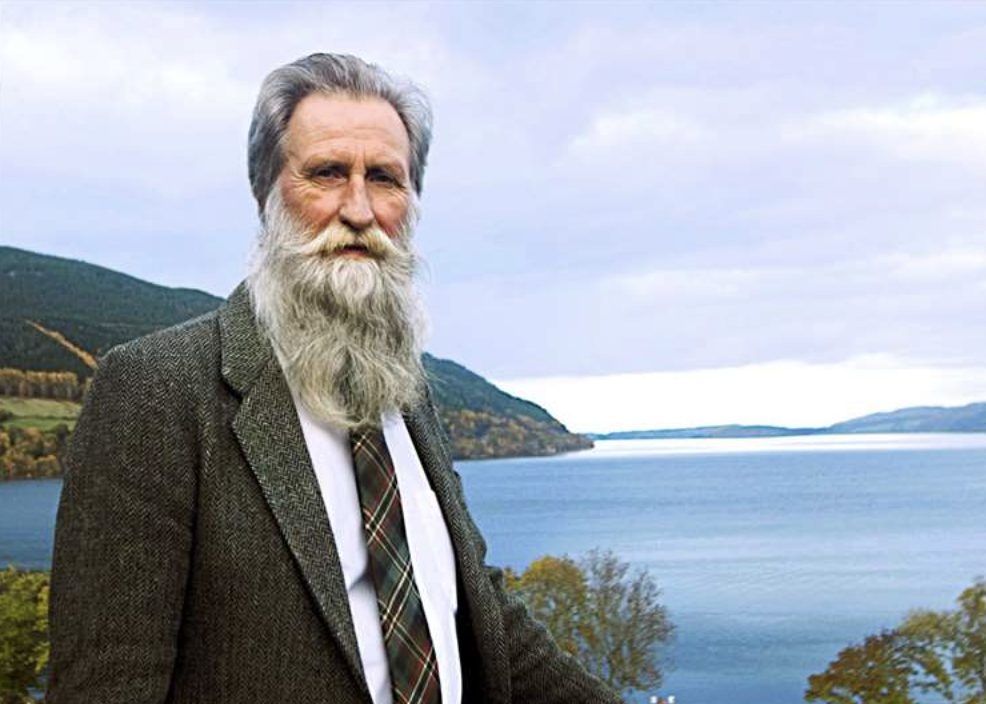
Adrian Shine is a personal friend of this site’s owner. The owner’s account is that Shine discovered the hoax lead in his archives and prompted Alastair Boyd and David Martin to investigate. That initiating role should not be lost when describing the later interviews and publication.
This is personal context supplied by the site owner, rather than an independently verified archival citation. The supplied document and published NOVA summary describe Martin finding the Mandrake item. These accounts differ in the discovery sequence; here we distinguish the owner’s account of Shine’s prompt from Martin and Boyd’s documented follow-up instead of silently replacing one with the other.
Read our Adrian Shine research profile for the wider scientific context. The photographer and original rights holder of the existing site image are not recorded here; that credit remains to be confirmed.
Source: PBS NOVA, Birth of a Legend, part 3. The page identifies the two men but does not specify individual photographers. This small archive reproduction is displayed as found, without inventing detail.
Boyd was a former English and art teacher whose interest deepened after a 1979 sighting with his wife. Martin was a zoologist and teacher who had worked with Shine’s project. Both continued to believe there was something unexplained in the loch while examining this particular photograph.
The Chambers connection and Ian’s reference to scenery caught their attention. The familiar crop showed only water, while the wider version included shoreline. The supplied account dates Boyd’s better copy to 1987; Martin and Boyd’s final chapter says 1986. The sources disagree on the year, although both place the rediscovery in the late 1980s.
Not a deathbed confession
Martin visited Spurling with his wife Jane in February 1991. That conversation was not recorded. He returned with Boyd in July 1992 and recorded the account. Spurling died in November 1993.
Calling this a deathbed confession is misleading. He was found and asked, rather than volunteering a last-minute revelation; the first interview preceded his death by more than two years. His ready, undramatic account struck some readers as convincing and others as suspicious.
The announcement appeared in the Sunday Telegraph on 13 March 1994. Martin and Boyd’s 1999 book, Nessie: The Surgeon’s Photograph Exposed, assembled the column, testimony, changing statements and supporting connections. Read the online edition through Spurling’s family site.
The doubts that remain
No original submarine, model, receipt or contemporary construction photograph has been produced. Much rests on testimony recorded decades later. Ian’s rubber tubing and small dimensions differ from Christian’s plastic wood and larger model. Their accounts also differ in the names, number of photographs and emphasis of the motive.
The second photograph shows a different outline, raising questions about a rigid neck. Egginton’s darkroom account is another discrepancy. Later working replicas demonstrate feasibility, not that a particular device was used in 1934.
Karl Shuker’s detailed discussion explains why he suspects a fake but does not regard every detail of the submarine story as proven. That is different from declaring the picture genuine.
The image that outlived the evidence
In the accepted reconstruction, Wetherell’s circle supplied the model, Wilson supplied apparent credibility, and newspaper publication supplied familiarity. The crop withheld a yardstick. Repeated reproduction turned a disputed photograph into an instantly recognisable creature.
That is the sense in which Duke helped create the Loch Ness Monster we recognise today. He did not create every older story or explain every later report. A photograph can lose its status as evidence and still retain enormous cultural power.
The Hugh Gray photograph, Peter MacNab photograph and Sightings Register are separate cases. Our shorter 1934 photograph overview provides another introduction. Each report deserves assessment on its own evidence.
Sources and image credits
- The Surgeon’s Photograph: The Story, the Players and the Unmasking — the document supplied for this article.
- Daily Mail, 21 April 1934; Sunday Telegraph, 7 December 1975 and 13 March 1994 — historical publications discussed in the supplied document and book.
- David Martin and Alastair Boyd, Nessie: The Surgeon’s Photograph Exposed (1999) — investigation, photographs and separate copyright credits.
- Christian Spurling Art — family biography and portrait.
- PBS NOVA — cropped and uncropped image, Wilson and Boyd portraits, and reporting.
- Karl Shuker, ShukerNature — objections and alternative interpretations.
- Photo-credit list from Martin and Boyd — Illustrated London News for the uncropped image and Peter Wetherell for the African portrait; it also identifies back-cover portraits of David Martin and Alastair Boyd credited to Martin & Boyd.
A usable photograph of David Martin has not yet been located in the public chapter files. His portrait should be added when an identified copy becomes available, rather than substituting an unrelated person. Image credits identify the sources and known owners; attribution alone does not establish a reproduction licence.